The Dubai 2040 Urban Master Plan is the long-term city-development blueprint that structures how Dubai will grow from its 2021 baseline through 2040. Adopted in March 2021 by HH Sheikh Mohammed bin Rashid Al Maktoum, the plan organises growth around five urban centres, doubles green space, expands public beaches by 400 percent, and projects a resident population of 5.8 million. Five years in, several headline targets have moved from paper to construction, while others remain in the design phase.
This guide is a 2026 progress check on the Dubai 2040 plan: what was promised, what is already visible on the ground, what is still ahead, and how that picture should shape your decisions if you are considering moving to Dubai or putting capital into the city. We write this from the seat of a Dubai-based business setup firm that tracks the plan continuously because where our DACH and international clients choose to live or invest depends on it.
The Dubai 2040 Urban Master Plan in 60 Seconds
The plan reorganises Dubai's growth around five anchor centres instead of one continuous sprawl. It doubles the green and leisure footprint, multiplies public beach length, lifts public-recreation area by 60 percent, and prepares the city for a daily population of 7.8 million including commuters and visitors. It runs in five-year increments. The 2025 quinquennium has already delivered several signature projects: the Blue Line metro contract awarded in 2024, the activation of Expo City as a fully zoned urban district, and the early phases of Dubai's beach expansion programme.
Read alongside the Dubai property market 2026 outlook, the master plan is the single most important context for understanding why certain neighbourhoods are seeing price acceleration and others are not.
The Five Centres of the Dubai 2040 Plan
Dubai 2040: The Five Anchor Centres
Two established centres preserve existing cores. Three growth centres mark the directions Dubai is reorganising around.
Downtown + DIFC
Financial and lifestyle core
Downtown Dubai, DIFC, Business Bay, Za'abeel
Dubai Marina + JBR
Tourism and leisure spine
Marina, JBR, Bluewaters, Palm Jumeirah
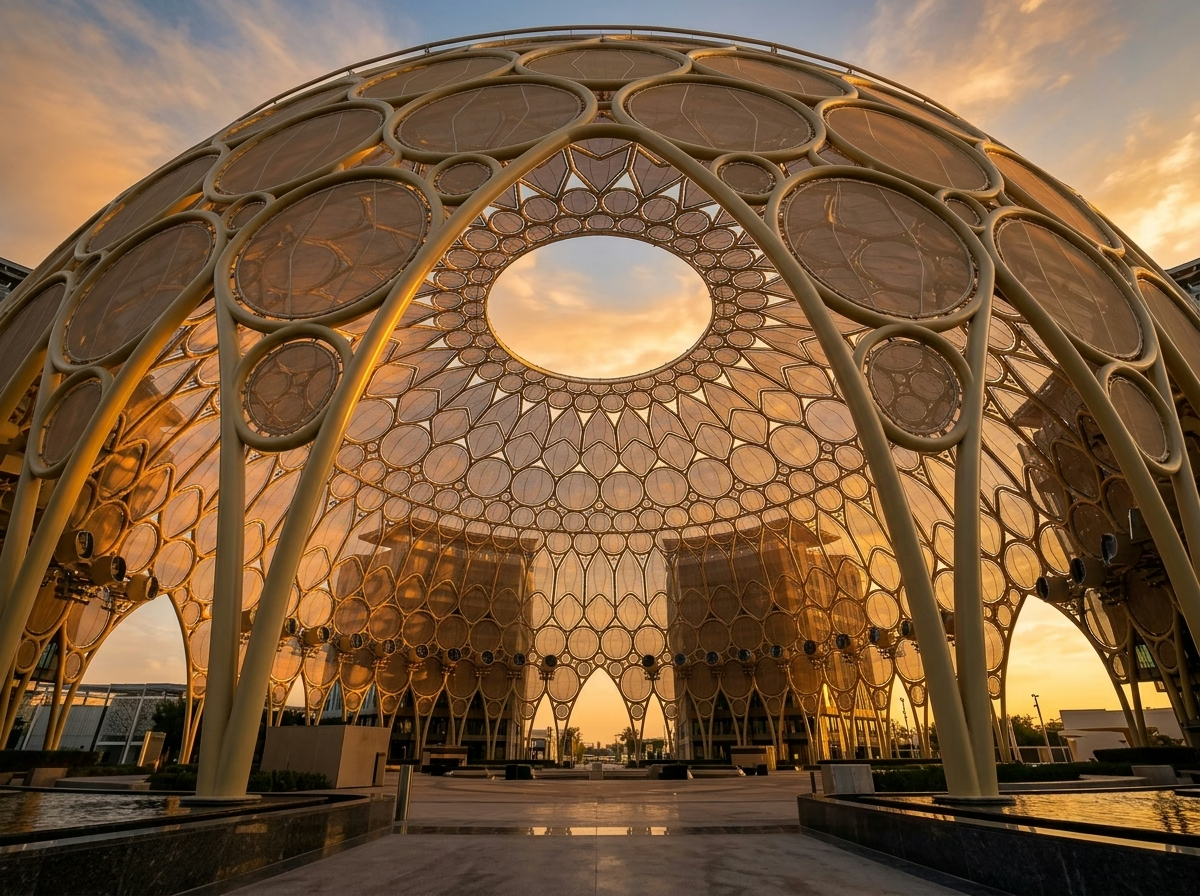
Expo City
Innovation and exhibition centre
Expo City Dubai, Dubai South gateway
Deira + Bur Dubai
Heritage and culture centre
Deira waterfront, Al Fahidi, Dubai Creek, Dubai Islands
Dubai Silicon Oasis + DIAC
Knowledge and academic centre
DSO, Academic City, Dubai Outsource City
Source: Dubai 2040 Urban Master Plan, adopted March 2021
The five-centre model is the structural heart of the plan. Two centres preserve existing established districts; three centres designate growth poles in directions Dubai has historically under-developed.
| Centre | Role | Anchor districts | Current status |
|---|---|---|---|
| Downtown + DIFC | Historic financial and lifestyle core | Downtown Dubai, DIFC, Business Bay, Za'abeel | Operational, densifying |
| Dubai Marina + JBR | Established tourism and leisure spine | Dubai Marina, JBR, Bluewaters, Palm Jumeirah | Operational, beach-expansion phase active |
| Expo City | Innovation and exhibition centre | Expo City Dubai, Dubai South gateway | Active, transitioning from event site to permanent district |
| Deira + Bur Dubai (historic) | Cultural and heritage centre | Deira waterfront, Al Fahidi, Dubai Creek | Renaissance phase, Deira waterfront redevelopment underway |
| Dubai Silicon Oasis (DSO) + DIAC | Knowledge and academic centre | DSO, Academic City, Dubai Outsource City | Operational, expansion in planning |
Two consequences flow from the centre model. First, infrastructure investment concentrates where the plan says it concentrates: metro lines, schools, parks, and beaches go to anchor districts before satellite zones. Second, the plan's geometry rewards property owners in or adjacent to the five centres and is neutral or negative for owners in zones the plan does not name.
What this means for new residents
If you are reading the master plan to decide where in Dubai to live, the practical signal is: lean toward an anchor district inside one of the five centres. The five-centre framing is the strongest tailwind a Dubai neighbourhood can have through 2040. Established centres like Downtown and Marina already command price premiums; growth centres like Expo City and Deira renaissance districts are where the next decade's appreciation is concentrated. The full picture of monthly outgoings, from rent and utilities to transport and schooling, is in our breakdown of Dubai living costs.
Population, Density, Area: What Doubles Under the Dubai 2040 Plan
The targets are explicit and were published by the UAE government's official portal when the plan was adopted in March 2021. Most of the headline numbers cluster around a single idea: Dubai roughly doubles in resident population and triples in daily population while reorganising density around the five-centre model rather than letting growth dissipate at the edges.
| Indicator | 2021 baseline | 2040 target | Change |
|---|---|---|---|
| Resident population | ~3.3 million | 5.8 million | +76 percent |
| Daily population (incl. commuters and visitors) | ~4.5 million | 7.8 million | +73 percent |
| Green and leisure space | Baseline | +100 percent | Doubled |
| Public beach length | Baseline | +400 percent | Five-fold |
| Public recreation area | Baseline | +60 percent | More than half |
| Urban centres | Mostly mono-centric | 5 anchor centres | Polycentric |
| Plan adoption | March 2021 | n/a | n/a |
The composition of growth matters more than the headline. Of the projected 5.8 million residents, the plan does not anticipate continuous sprawl. Instead, growth concentrates inside the five centres and the rural and natural hinterland is protected. Sixty percent of the emirate's land area is preserved as natural reserves or rural countryside under the plan, which is a structural commitment the Khaleej Times reported on adoption.
Green Space, Beaches, Mobility: The Liveability Targets
Dubai 2040 vs 2021: What Doubles, What Quintuples
Baseline year 2021 vs target year 2040. Visual proportions show the scale of change.
Source: Dubai 2040 Urban Master Plan, UAE government portal (u.ae)
The Dubai 2040 plan does not only describe how big the city will be. It also describes how liveable it intends to be. Three liveability metrics carry the plan's identity.
Green space doubled
Dubai will double its total green and leisure footprint by 2040. The mechanism is a network of "20-minute neighbourhoods" in which residents reach 80 percent of daily needs within a 20-minute walk or bicycle ride, including a green or shaded public space. Implementation is partly visible already in Al Wasl, parts of Jumeirah, and inside the master-planned communities of Dubai South and Mohammed Bin Rashid City.
Beaches expanded by 400 percent
Public beach length grows five-fold. Phase 1 expansion has begun along Jumeirah Beach and at La Mer; the second phase extends along the Deira waterfront and into the Dubai Islands development. The 400 percent figure means a city that today has roughly 21 kilometres of public beach will end the plan period with over 100 kilometres of publicly accessible coastline.
Mobility through metro and active transport
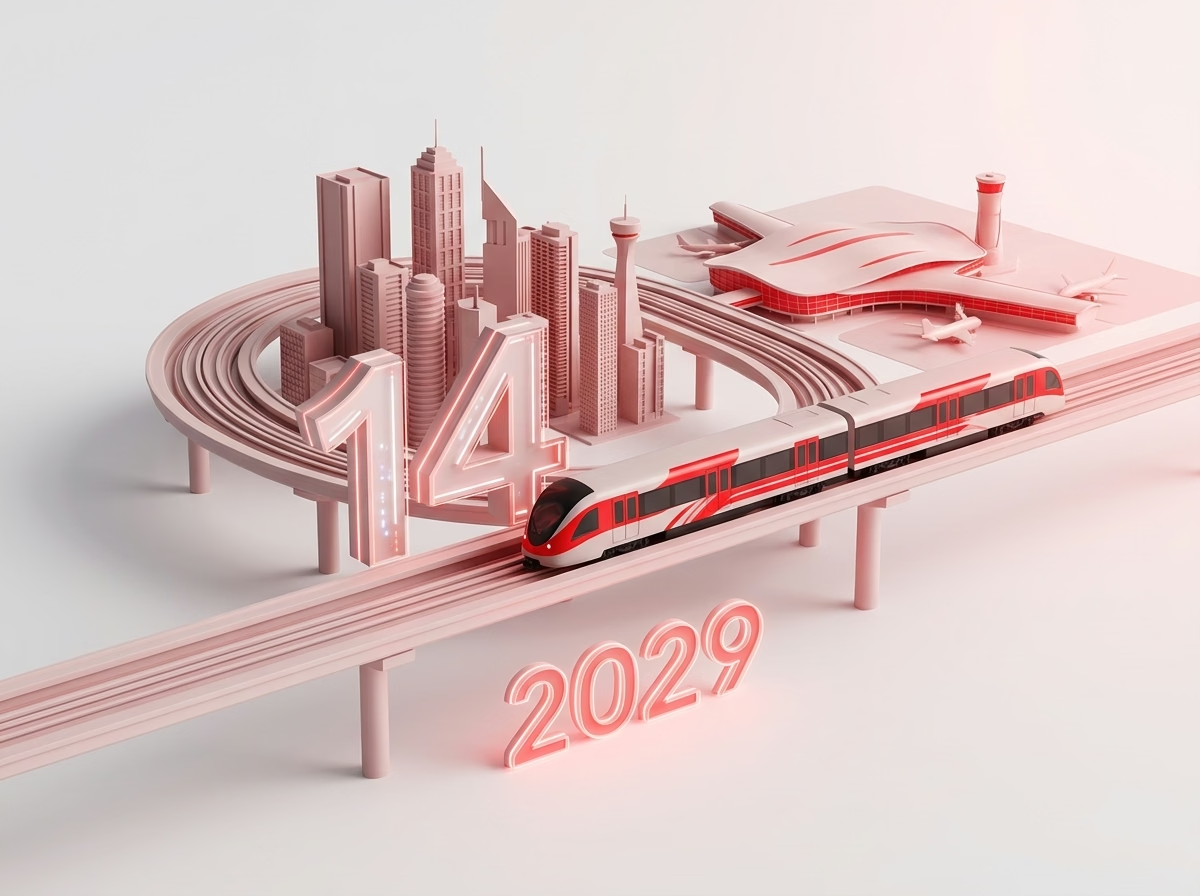
Public transport modal share is targeted to rise sharply. The single largest delivery commitment is the Blue Line metro, awarded in November 2024 and scheduled for operation by 2029. The line extends the metro network to Mirdif, International City, and Dubai Silicon Oasis, connecting two of the five centres directly. Cycling network expansion and pedestrian-priority redesigns inside the five centres carry the remainder of the modal-shift load.
2026 Progress: What Is Already Delivered Under the Dubai 2040 Plan
Dubai 2040: 2021 to 2026 Progress Check
What has actually been delivered five years into the 20-year plan.
MARCH 2021
Dubai 2040 Urban Master Plan adopted Done
Approved by HH Sheikh Mohammed bin Rashid Al Maktoum. Five-centre model and 2040 targets formalised.
2021 / 2022
Expo City Dubai transition begins Done
Site converts from event venue to permanent urban district with residential and innovation zoning.
2023
Jumeirah Beach expansion phase 1 complete Done
Approximately 6 km of new public beach access opens along the Jumeirah corridor.
NOVEMBER 2024
Blue Line metro contract awarded Done
Construction begins on the line connecting Downtown to DSO via Mirdif and International City. Operational target 2029.
2025
Dubai Islands construction active In Progress
First hospitality and residential phases launching; Deira-side island reclamation ongoing.
2026
20-minute neighbourhood pilots In Progress
Live in parts of Al Wasl and Mohammed Bin Rashid City. Deira Renaissance and DSO expansion remain in planning.
Source: Dubai 2040 Urban Master Plan, 2026 progress check
Five years into the 20-year plan, the question is no longer "what does it propose" but "what is actually happening." The honest 2026 progress picture is partial delivery, concentrated in mobility and selective beach expansion.
Delivered or under construction
- Blue Line metro contract awarded (November 2024). Construction is active. Two of the five centres (Downtown and DSO) and several growth districts are being connected.
- Expo City Dubai activated as a permanent urban district. Following the 2020 Expo (held in 2021), the site has transitioned from event venue to a zoned residential-and-innovation district with its own residential phases launching.
- Jumeirah Beach expansion phase 1 complete. Roughly 6 kilometres of additional public beach access has opened along the Jumeirah corridor.
- Dubai Islands construction active. The Deira-side island development is mid-construction and the first hospitality and residential phases are launching.
- 20-minute neighbourhood pilots launched in selected communities including parts of Al Wasl and Mohammed Bin Rashid City.
What is still on paper
- Deira Renaissance redevelopment has approved master planning but limited visible construction beyond Dubai Islands.
- DSO + Academic City expansion under the knowledge-centre framework is in planning, not delivery.
- The full 100 km beach expansion is at roughly 20 percent of target.
- Population trajectory is tracking but residential delivery is concentrated in growth districts rather than infill of established centres.
The pattern is consistent with most 20-year urban plans. Infrastructure with long lead times (metro, beach reclamation, district redevelopment) is committed early. Density and population targets follow as the infrastructure becomes operational.
What This Means for Where to Live or Invest
The Dubai 2040 plan is not abstract policy. It is the single best forward indicator of which neighbourhoods will see appreciation, which schools and hospitals will open, where transport will reach, and which beach you will be able to walk to in 2035. Three practical takeaways for international residents and investors.
One: lean toward an anchor district inside one of the five centres
The plan's geometry rewards centre-anchored locations. For a relocating DACH family looking at Downtown, Dubai Marina, or Mohammed Bin Rashid City, the master plan is a structural tailwind. For investors comparing growth districts, Expo City and the Deira renaissance corridor have the longest delivery runway and the most plan-driven catalysts ahead.
Two: time horizon matters more than entry price
For relocation purposes the master plan signals quality of life trajectory more than headline price. A neighbourhood inside a named centre with planned metro access in 2029 is a different proposition in 2026 than a similar-priced neighbourhood outside the centre framework. For an investor with a five-to-ten-year horizon, this is the most actionable signal in the plan.
Three: business district expansion creates new setup opportunities
For founders weighing where to incorporate, the centre model concentrates new commercial real estate, free-zone expansion, and corporate-headquarters activity in named centres. Expo City and DSO host two of the most active free-zone expansions of the decade. Founders sizing up the full picture should also read our breakdown of Dubai company setup costs, which factors free-zone choice and physical-presence requirements.
Links to Blue Line, Expo City, and Dubai South
Dubai's 2040 vision does not stand alone. It connects to three other ongoing transformations that DACH readers regularly ask us about. The Blue Line metro is the plan's flagship mobility delivery. Expo City Dubai is the plan's flagship growth-centre activation. Dubai South, although not named as one of the five centres in the master plan's centre model, is the plan's flagship southern expansion corridor and home to Al Maktoum International Airport, which will eventually become the world's largest passenger airport. Each of these stories is a chapter of the same overall plan. Our coverage of the Blue Line and Expo City articles, when published, will go in the cluster alongside this pillar.
For DACH residents planning a move and considering all of these factors together, the broader Dubai relocation playbook covers the visa, banking, schooling, and tax layers that sit alongside the master-plan geography.