The Dubai Metro Blue Line is the third line of Dubai's driverless metro network. It adds 30 km of track, 14 new stations and a Y-shaped route that connects the airport corridor with Mirdif, Al Warqa, International City, Dubai Silicon Oasis and Academic City. The contract was signed in 2024 and the line is scheduled to open in 2029, with a forecast of around 320,000 daily riders once it ramps up. This Dubai Metro extension is the first major rail investment under the Dubai 2040 Urban Master Plan.
For DACH residents the practical question is simple: will the new line change where you live, where you set up an office, and how long you spend in a car each week? This guide walks through the route, the 14 stations, the timeline, and the rent and commute implications, with the UAE Government Portal Dubai 2040 page and the Reuters report on the AED 18.2 billion contract as the primary sources.
What the new line is
The current Dubai Metro has two lines. The Red Line runs roughly parallel to Sheikh Zayed Road from Centrepoint in Rashidiya through downtown to Expo City. The Green Line loops through Deira, the Creek and Dubai Healthcare City. Both have been carrying around 800,000 passengers a day combined and have been the backbone of Dubai's public transport since 2009.
The Blue Line is the long-planned third line. It does not run parallel to either existing line. Instead it threads through the eastern and southern parts of the city that the current network does not reach, then plugs into Dubai International Airport. That is the structural point: the line is not a duplicate, it is a coverage extension into neighbourhoods that have grown faster than the metro.
Route shape: a Y, not a straight line
The Dubai Metro Blue Line has a Y-shape. The two arms split at Centrepoint Station (the current Red Line eastern terminus, then known as Rashidiya). One arm runs east through Mirdif, Al Warqa and on to International City and the academic / tech belt at Dubai Silicon Oasis and Academic City. The other arm runs north toward Dubai International Airport and an interchange with the existing Red Line at Centrepoint.
Total length: roughly 30 km. The branching design means a single line serves three different commuter flows at once: the airport, the residential east, and the southern education / tech corridor.
Blue Line stations 2029: the full list
Dubai Metro Blue Line: timeline to 2029
14 stations. 30 km. AED 18.2 billion contract awarded.
The Blue Line stations 2029 lineup spans communities that, until now, have had no rail option at all. The full station list runs through the corridor below. Stations marked as interchanges connect directly to the existing Red Line.
| # | Station | Neighbourhood / Anchor | Notes |
|---|---|---|---|
| 1 | Centrepoint (interchange) | Rashidiya | Red Line interchange, Y-junction |
| 2 | Mirdif City Centre | Mirdif | Major mall + dense residential |
| 3 | Mirdif Hills | Mirdif | Mid-rise residential |
| 4 | Al Warqa | Al Warqa | Villa belt, schools |
| 5 | Al Khawaneej | Al Khawaneej | Established villa community |
| 6 | International City 1 | International City | Country-themed clusters, high rental demand |
| 7 | International City 2 | International City | Extension of cluster network |
| 8 | Ras Al Khor | Ras Al Khor Industrial | Wildlife sanctuary + industrial spine |
| 9 | Dubai Silicon Oasis | DSO | Tech free zone, residential towers |
| 10 | Academic City | Academic City | Universities and student housing |
| 11 | Al Jaddaf (Mohammed bin Rashid Library) | Al Jaddaf | Cultural anchor near Festival City |
| 12 | Dubai Festival City | Festival City | Mall + waterfront residential |
| 13 | Dubai International Airport (Terminal 2) | DXB | Direct airport connection |
| 14 | Emirates / DXB consolidated terminal | DXB | Pending Terminal 2 / consolidation works |
A couple of station names remain provisional pending RTA's final wayfinding sign-off, but the corridors and interchange points are locked in the awarded scope. Where you see a marked interchange, the platform layouts are designed so a passenger can switch from Red to Blue without leaving the paid zone.
Why the airport leg matters
Dubai International Airport handles around 90 million passengers a year and has no direct rail link from Dubai's eastern residential belt. Today, a Mirdif or Al Warqa resident catching a flight either drives, takes a taxi, or chains two buses. The new airport leg collapses that into a single 20 to 25 minute ride. For a DACH resident running a Dubai office and flying to Frankfurt or Munich twice a month, that is a meaningful change to the weekly logistics.
Timeline: where the project is in 2026
The Dubai Metro extension is in construction. Civil works started in late 2024 after the contract was awarded to a Turkish-Chinese consortium of Alarko / ALSIM and CRRC at a contract value of AED 18.2 billion. The schedule the RTA has communicated publicly puts opening in 2029, with the consolidation of airport approaches as the final piece.
There is no public revised date suggesting a delay. There is also no scenario the RTA has communicated that brings opening forward. Plan on 2029 and revisit only if the RTA publishes an updated milestone.
The milestones at a glance:
- 2024: Contract awarded; design freeze; site mobilisation
- 2026 (now): Foundation works at multiple stations; tunnelling on the airport arm; viaduct piers visible along the Mirdif and International City corridors
- 2027 to 2028: Construction peak; track and systems installation; first stations weather-tight
- 2029: Opening, with stations phased in over the first six months as commissioning completes
The construction visibility on the ground (piers, hoardings, deviated traffic) is the most reliable indicator of where the work has reached. As of mid-2026 the most active visible work is along the Mirdif and Al Warqa corridors and at Centrepoint.
Rent and commute implications
Mirdif to DXB Terminal 1: the commute before and after
One worked example. Same trip, three modes today, one new mode in 2029.
Three realistic options
One option, one seat
This is the part DACH readers usually want quantified. New metro stations move rents. The Red Line's opening in 2009 lifted rental values along the Sheikh Zayed Road corridor by a documented margin, and the same pattern is already visible in early Blue Line corridors, even with the line still three years from operation.
Where the rent uplift is likely to land
The neighbourhoods with the largest expected uplift, ranked by current pricing gap to comparable Red-Line-served areas:
- Mirdif and Mirdif Hills. Today Mirdif rents are 25 to 35 % below Jumeirah Village Circle and 40 % below Dubai Marina for comparable two-bedroom apartments. The new station closes the metro-access gap. Expect Mirdif to compress that discount over 2027 to 2029.
- Al Warqa. Today an almost car-only neighbourhood. Adding a station fundamentally changes the access profile. Villa rents have already started moving in 2025 to 2026.
- International City. Currently among the cheapest rental options in Dubai. The metro connection will pull entry-level renters who today choose closer-in neighbourhoods purely because of car-free access.
- Dubai Silicon Oasis. Already attractive for tech workers but historically constrained by commute to anywhere west. Direct metro to the airport and to Centrepoint changes that.
For a granular look at how rent fits into total monthly cost, the Real Cost of Living in Dubai guide breaks down housing, utilities, transport and groceries together. Rent is the line item this Dubai Metro extension most directly touches.
Where the rent uplift will be smaller
Centrepoint and Festival City are already on the existing network or close enough to it that the new line is a convenience boost rather than a structural change. Academic City and Ras Al Khor are not residential in the conventional sense, so the impact is on workplace-access pricing more than apartment rent.
Buying near a future station
For DACH readers thinking about buying rather than renting, the calculation is different. Property prices have a longer feedback loop than rents, and the new line's effect tends to price in earlier on the buying side. Off-plan launches near confirmed Blue Line stations 2029 destinations have been pricing 10 to 15 % higher than identical projects further away from a station, based on 2025 to 2026 launch data. For a DACH-specific overview of the buying process, see the property purchase guide for German buyers.
What this means for office location
DACH founders setting up a Dubai entity often optimise for a free zone whose office happens to be close to the metro. Until now that has biased the decision toward DMCC (on the Red Line) over IFZA in Dubai Silicon Oasis or Meydan. The free zone comparison between DMCC, IFZA and Meydan gets at this tradeoff in detail.
With the new line opening, the math shifts. IFZA's Dubai Silicon Oasis office becomes a metro-served location. Meydan stays car-only. For a founder weighing total commute time, accessibility for employees who do not drive, and ease of client visits, IFZA on the new line is a different proposition than IFZA on no metro. This is one of the few infrastructure changes that meaningfully affects the free-zone choice for an office-using business. Cost-wise, the cost of starting a company in Dubai breakdown still favours IFZA on licence fees, and now the metro argument supports it too.
What the project is part of
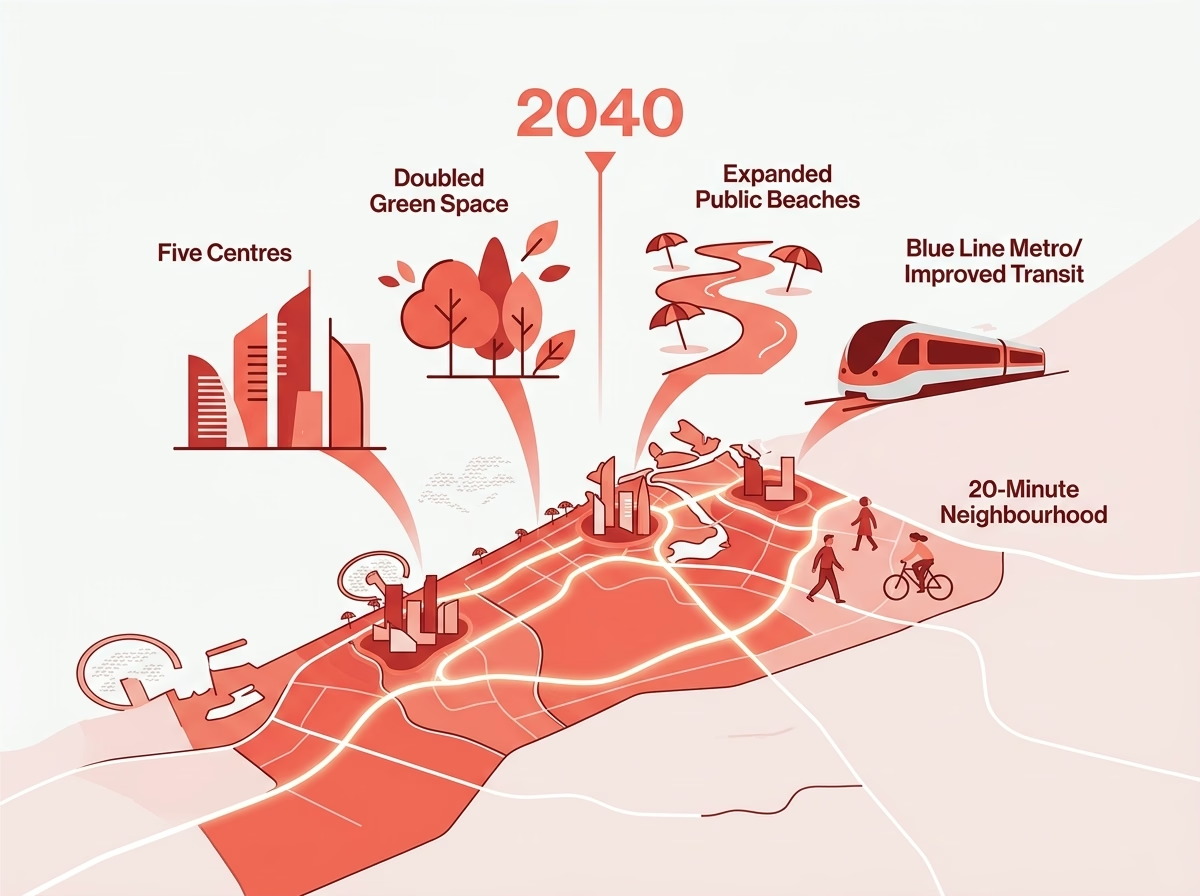
This Dubai Metro extension is the transit backbone of the Dubai 2040 Urban Master Plan. The Plan reorganises the city around five urban centres connected by a denser transit network, with a stated goal of cutting average commute time and shifting more daily trips off private cars. The current build is the first major metro investment under that plan, with further metro and tram extensions sequenced through to 2040.
For DACH readers planning a multi-year move, the practical takeaway is that this is not a one-off project. The metro footprint Dubai will have in 2030 is materially different from the 2024 footprint, and decisions made now (where to lease, where to buy, where to base an office) sit better when they account for the network the city is building, not the one it has today. The Moving to Dubai from Germany guide covers the broader relocation picture this fits into.
How a Mirdif to airport commute changes
To put numbers on the change, take one concrete example. A resident in Mirdif City Centre flying out of DXB Terminal 1 today has three realistic options: drive (around 25 minutes off-peak, 45 to 60 minutes peak, plus AED 50 to 70 in parking per day if you leave the car), taxi (around AED 70 to 90 plus tip), or two buses (around 65 minutes plus walk). Once the new line opens, the same trip is a single seat ride of around 20 to 25 minutes for AED 8, with luggage handling at both ends.
For a resident who flies six times a year that is somewhere in the range of AED 2,000 to 3,000 a year saved and around 20 hours back, plus the qualitative gain of not driving through Garhoud at rush hour.