Yes, alcohol is legal for non-Muslim adults in Dubai, but only under a specific set of rules covering who can buy, where you can drink, and what happens if you cross a line. The legal drinking age is 21. This guide covers what most people need next: how residents get the free liquor licence, how much you can bring through the airport, where to buy, what changes in Ramadan, and the penalties in the law. If you only have one minute, the headline is simple: drink in licensed venues, never drive after a sip, and respect Ramadan.
This article presents the rules factually as they stand in 2026. Regulations around alcohol in Dubai have evolved significantly since 2019, and details continue to change. Always confirm the current state with your venue, retailer, or the relevant Dubai authority before relying on a specific detail for an important decision.
Quick answer: Is alcohol legal in Dubai?
Alcohol in Dubai is legal for non-Muslims aged 21 and over. It is served in licensed hotels, restaurants, bars, and clubs across the emirate. No personal licence is needed to drink at a licensed venue. To buy from a shop, you need a personal liquor licence. It is free since January 2023. Residents apply with an Emirates ID, and tourists get a free permit at the till by showing a passport.
The rules are stricter than in many Western countries on three points. You cannot drink in public. The legal blood-alcohol limit for driving is zero. And other emirates, notably Sharjah, follow different rules. Stick to licensed venues, take a taxi if you have had even one drink, and you will be fine.
Who can buy and consume alcohol in Dubai
The legal drinking age in Dubai is 21. This applies in every licensed venue, on hotel grounds, and at retail outlets that sell alcohol. ID checks are routine and your passport or Emirates ID will be requested. Anyone under 21 cannot lawfully buy, be served, or consume alcohol in Dubai, and supplying minors carries heavy penalties.
Alcohol is intended for non-Muslim adults. Muslims are not permitted to consume alcohol under UAE law, and that rule applies regardless of nationality.
The picture across the seven emirates is not uniform. Dubai is the most liberal on alcohol after Abu Dhabi's 2020 reforms, while Sharjah remains a dry emirate where alcohol is not sold or served in licensed venues. Ajman, Umm Al Quwain, Ras Al Khaimah, and Fujairah each maintain their own rules; if you cross emirate borders for a day trip, do not assume the same access. The rules in this article apply specifically to alcohol in Dubai unless stated otherwise.
How to get a Dubai liquor licence in 2026
A Dubai liquor licence is a free personal permit that lets a non-Muslim resident aged 21 or over buy alcohol from a licensed shop. You do not need it in bars, hotels, or restaurants, because those venues hold their own licence. You do need it to buy from a shop or a delivery app, including for drinking at home.
Who can apply
- Non-Muslim residents aged 21 or over
- You need a valid UAE residence visa and Emirates ID
- Visitors use the separate Tourist Liquor Permit instead (see below)
How to apply, step by step
- Choose a licensed retailer. In Dubai, these are MMI and African+Eastern.
- Apply in one of their stores, on their website, or in the LicenseDXB app. Have your Emirates ID ready.
- Fill in your personal details. There is no fee.
- The application goes to Dubai Police for approval. The retailers now say the app takes minutes. Older guidance spoke of two to four weeks, so allow some time.
- Once approved, show the licence and your ID at the till each time you buy.
Cost and validity
The licence is free. Dubai dropped the old AED 270 yearly fee in January 2023. A resident licence is valid for 12 months. Renew it the same way before it runs out.
Note that Dubai removed the cost, not the requirement. It was Abu Dhabi, not Dubai, that dropped the licence requirement outright in 2020.
Where you can drink in Dubai
- Licensed hotel bars, restaurants, lounges
- Licensed standalone restaurants and bars
- Licensed nightclubs
- Licensed beach clubs and pool clubs
- Private homes (residents 21+)
- Licensed private events and weddings
- Public streets, pavements, parks
- Public beaches not attached to a licensed club
- Metro stations and public transport
- Workplaces (without licensed event)
- Government buildings, religious sites
- Inside any vehicle, including taxis
Drinking alcohol is permitted in:
- Licensed hotels (rooftops, bars, restaurants, lounges)
- Licensed restaurants and bars outside hotels (most signature dining venues across Dubai)
- Licensed nightclubs (mostly inside hotels and select standalone venues)
- Licensed beach clubs and pool clubs (day-pass venues with full bar service)
- Private residences (for non-Muslim residents of legal age)
- Licensed private events (weddings, corporate functions held in approved venues)
Drinking alcohol is not permitted in:
- Public streets, pavements, parks, public beaches, and Metro stations
- Workplaces (unless an explicit licensed event)
- Government buildings and religious sites
- Vehicles, including taxis, private cars, and ride-hailing vehicles
- Open beaches not attached to a licensed beach club
The line is sharp. Walking from a licensed bar to your hotel with an open drink, or sipping a takeaway cocktail on the Marina promenade, is a public-consumption offence even though the drink itself was bought legally.
The Tourist Liquor Permit
Visitors arriving in Dubai can obtain a Tourist Liquor Permit free of charge at the point of purchase from approved retailers. The permit covers personal consumption during a 30-day stay and is issued at the till after a quick passport scan.
What the permit allows:
- Buying alcohol from licensed retailers (MMI, African+Eastern) for personal consumption
- Carrying the alcohol home to your hotel or rental apartment in a sealed bag
- Drinking it inside your private accommodation
What the permit does not allow:
- Drinking outside licensed premises or your private accommodation
- Sharing or selling the alcohol to third parties
- Carrying open or partially consumed bottles in public
The Tourist Liquor Permit is for visitors. Residents buy from the same licensed retailers using the free personal liquor licence described above.
If you would like a broader overview of the rules visitors should know on arrival, our guide to common fines in Dubai covers the wider picture.
Bringing alcohol into Dubai: the duty-free allowance
Arriving passengers aged 18 or over can bring in up to 4 litres of alcohol, or 2 cartons of beer. Each carton can hold 24 cans of up to 355 ml. That is the duty-free limit set out on the Dubai Customs list of permitted items.
What you need to know at the airport:
- It is either/or. The limit is 4 litres of wine or spirits, or the 2 cartons of beer.
- Under 18s get no alcohol allowance at all. The customs age is 18, but the drinking age in Dubai is still 21.
- Over the limit? You pay customs duty on the extra, or it is confiscated.
- Declare it if you are unsure. Declaring honestly is always cheaper than being caught.
- Sharjah is different. Alcohol is banned in Sharjah, so do not plan to take your bottles there.
Duty-free remains one of the easiest ways to stock up at competitive prices.
Buying alcohol in Dubai: shops, delivery and prices
There are three legal ways to get alcohol in Dubai:
- Licensed retailers (MMI, African+Eastern). Stores are spread across Dubai with broad ranges of beer, wine, and spirits. You show your licence or Tourist Liquor Permit plus ID at the till. Card payment is standard.
- Home delivery from the same retailers. Their apps and websites deliver, but you still need a licence, a verified account, and ID on delivery. Delivery from anyone else is not legal.
- Licensed venues for on-premises consumption. Hotels, restaurants, bars, and clubs serve drinks for consumption on site, not for takeaway.
Buying alcohol from any source other than a licensed retailer or duty-free is an offence.
Why prices went up in 2025. Dubai charges a 30% municipality tax on alcohol sold by licensed companies. It was suspended in January 2023, at the same time the licence became free. The tax came back on 1 January 2025, as Khaleej Times reported. The licence stayed free. Prices vary by venue and retailer, and some retailers absorbed part of the tax.
Drink-driving: zero tolerance
This is the single most important rule for any visitor or resident. The legal blood-alcohol limit for driving in Dubai is 0.0 mg/100 ml. Any detectable alcohol in your system, regardless of how recent or how small the amount, is treated as drink-driving. The current federal law is Federal Decree-Law No. 14 of 2024 on traffic, which took effect on 29 March 2025, according to the UAE government road safety page.
Penalties for driving under the influence of alcohol include:
- A fine of AED 20,000 to AED 100,000, jail, or both
- Licence suspension: at least 3 months for a first offence, 6 months for a second, and cancellation for a third
- Causing a death while drunk: at least one year in jail and a fine of at least AED 100,000
- Possible deportation for non-citizens, particularly in cases involving accidents
- Insurance void if you are involved in a collision while over the limit, leaving you personally liable for damages
Gulf News sets out these drink-driving penalties under the new law. Drink-driving is now a criminal case for the courts, not a simple traffic fine.
The practical implication is straightforward: if you have had even one drink, do not drive. Use a taxi, Careem, Uber, or one of Dubai's designated-driver services that will collect both you and your car. The cost of a ride home is a fraction of what a single mistake will cost. If you plan to drive in the UAE long-term, our guide to converting your driving licence walks through the process and the obligations attached.
Public intoxication
Even if you have drunk alcohol legally inside a licensed venue, leaving that venue visibly drunk and behaving disorderly in public is a separate criminal offence. Public intoxication can lead to:
- Detention by Dubai Police
- Fines
- Possible deportation for non-citizens
- A criminal record that can affect future visa applications
The rule is more strictly enforced at exit points around well-known nightlife zones. The simplest mitigation is to leave a venue in a controlled state, by taxi, and avoid drawing attention on the way out.
Alcohol during Ramadan
Ramadan is the Islamic holy month of fasting, observed by millions of Muslims across the UAE. Alcohol does not disappear in Dubai during Ramadan. Licensed venues keep serving, but the mood is quieter and you should plan ahead:
- Licensed venues keep serving alcohol, but some pause daytime service and serve only after sunset (iftar)
- Policies differ by venue, so call ahead if it matters to your plans
- Bars may still play music in the evening, but loud entertainment is toned down
- Eating, drinking, and smoking in public during daylight is discouraged out of respect
- Public consumption rules are enforced more strictly, including in hotel public areas during daylight hours
Ramadan dates shift each year because the Islamic calendar is lunar. Check the dates for the year you are visiting. For dress, eating in public, and working hours, see our guide to Ramadan etiquette in Dubai. The city does not close, but it shifts gears.
Penalties at a glance
| Offence | Penalty in the law |
|---|---|
| Drink-driving (any level) | AED 20,000 to 100,000 fine, jail, or both; licence suspended for at least 3 months |
| Causing a death while drunk | At least 1 year in jail and at least AED 100,000 fine |
| Drinking in public or in an unlicensed place | Jail, a fine, or both, set by the court |
| Public intoxication | Jail, a fine, or both; possible deportation |
| Supplying alcohol to anyone under 21 | Jail, a fine, or both; business licence at risk |
| Selling alcohol without a licence | Jail, a fine, or both; business closure |
| Bringing in more than the allowance | Customs duty on the excess, or confiscation |
The alcohol offences sit in Article 363 of the federal Crimes and Penalties Law (Federal Decree-Law No. 31 of 2021). The court sets the exact fine or jail term case by case. We do not quote figures for these offences, because published summaries of the law disagree on the amounts. Treat the table as a guide, not a tariff. If you find yourself in a situation involving alcohol and the police, request the consulate or embassy of your home country and seek qualified local legal counsel before signing or admitting anything.
Practical tips for newcomers and tourists
A short checklist that covers most situations:
- Carry your passport or Emirates ID. Retailers and venues check.
- Use ride-hailing or taxis after any drink, not just after a few. The zero-tolerance rule has no margin.
- Stock up at duty-free on arrival. Up to 4 litres, or 2 cartons of beer, at duty-free prices.
- Respect Ramadan timings and dress norms. Even if you are not fasting, the city is.
- Be cautious with social media. Photos that look harmless to you may read differently locally. Follow the same etiquette you would in any country with religious sensitivities.
- Save the address of a licensed venue, not a public spot, when meeting someone for drinks. No street, no park, no public-beach drinking.
- If invited to a private home, the host carries the licence responsibility. Ask politely; do not assume.
- Tourist Liquor Permit is free at the till. You do not need to apply in advance.
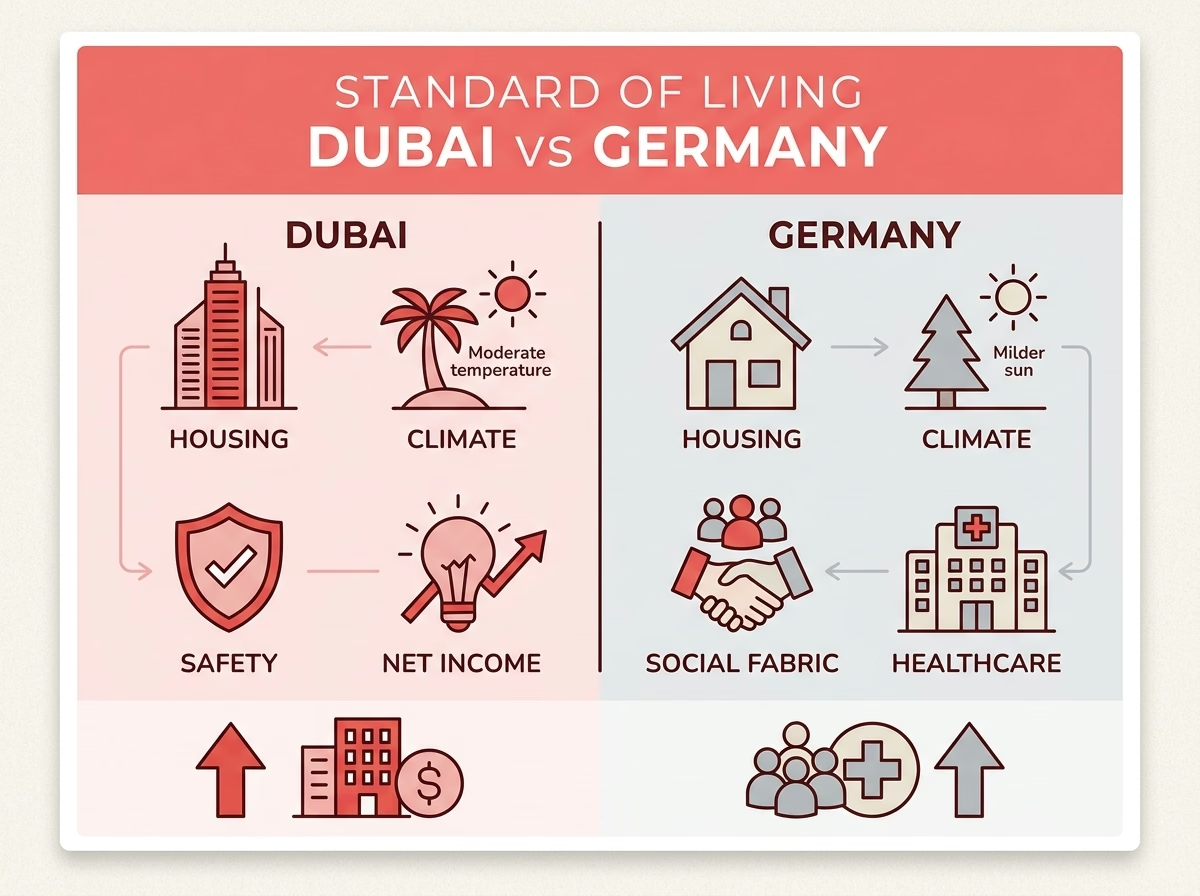
Newcomers planning a longer stay should also read our guide on moving to Dubai from Germany, which covers the full lifestyle adjustment alongside legal and tax implications.
What changed in 2026 (and what did not)
Alcohol regulation in Dubai has been reformed multiple times since 2019. The current 2026 position consolidates several of those changes:
- A personal liquor licence is still required to buy from licensed retailers in Dubai, but since January 2023 it is free of charge (Abu Dhabi is the emirate that dropped the requirement entirely)
- The 30% municipality tax on alcohol, suspended from January 2023, has applied again since 1 January 2025
- The Tourist Liquor Permit remains free at point of purchase for non-resident visitors
- Venue-level licensing remains the regulatory backbone, with hotels and standalone restaurants holding their own licences
- Drink-driving remains zero-tolerance, and the new federal traffic law in force since 29 March 2025 sets a fine of AED 20,000 to 100,000
- Sharjah remains dry; emirate-by-emirate variation continues
We do not anticipate sudden reversals to the more liberal direction of the past five years, but rules can adjust. Check official Dubai Police, Dubai Tourism, or your hotel for the latest position before relying on a specific detail.