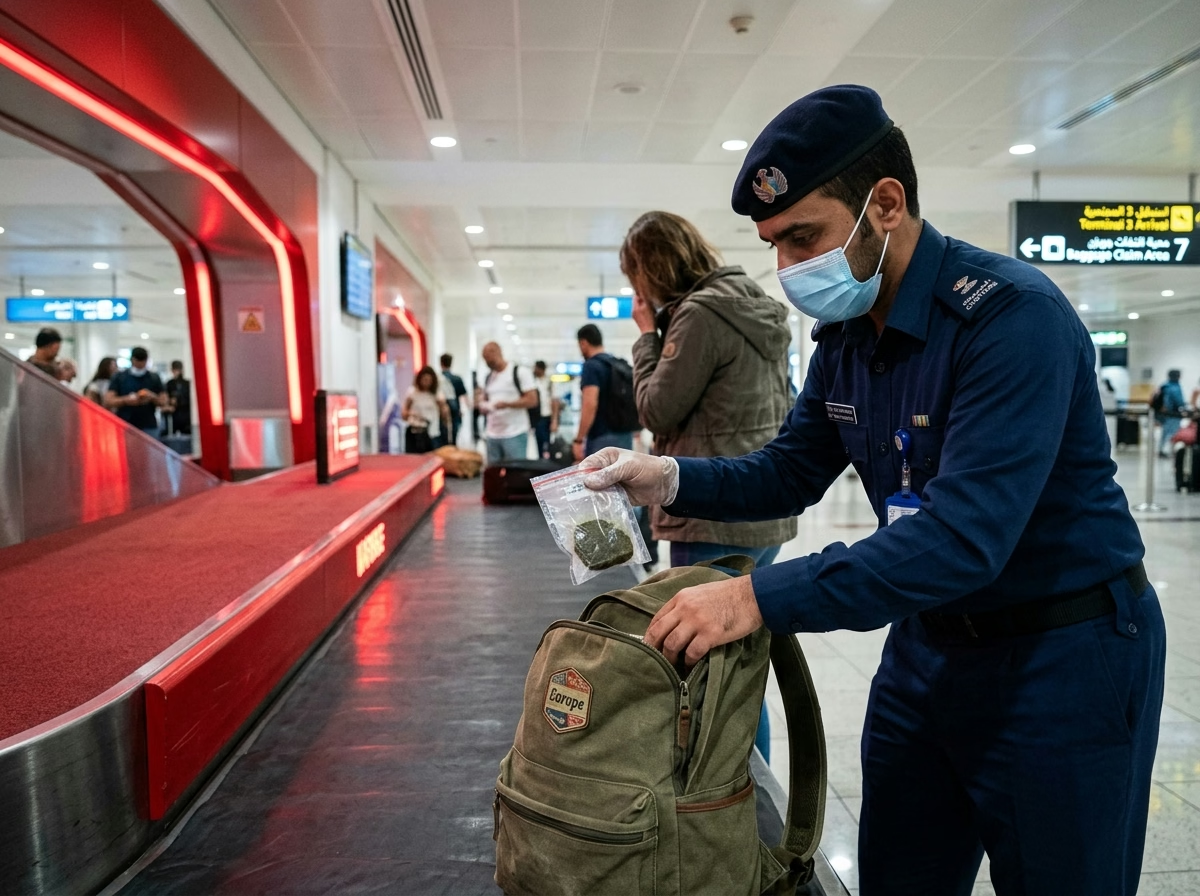
Dubai's drug penalties in 2026 sit under Federal Decree-Law No. 30 of 2021, the UAE's federal narcotics statute. Possession, use, sale, or trafficking, even in trace amounts, carries jail time, fines from AED 20,000 to over AED 100,000, and deportation for non-citizens. Tourists caught with small personal amounts at entry now face fines under Cabinet Decision No. 43 of 2024 instead of immediate jail, but the underlying federal law applies the moment quantities exceed personal-use thresholds. What counts as possession, what triggers a case, and how visitors end up arrested for substances legal at home: the full picture below.
Dubai follows the United Arab Emirates’ zero-tolerance policy on drugs. Federal laws strictly prohibit any involvement with narcotics or psychotropic substances.
UAE Drug Laws and Zero-Tolerance Policy
Dubai follows the United Arab Emirates’ zero-tolerance policy on drugs. Federal laws (specifically Federal Decree-Law No. 30 of 2021 and earlier Federal Law No. 14 of 1995) strictly prohibit any involvement with narcotics or psychotropic substances. This means possession, use, sale or trafficking of drugs – even in tiny amounts – is a serious crime. The Dubai drug laws are notoriously strict: even trace amounts found in your body (from prior use) can lead to charges. In practice, officials have arrested travelers for almost undetectable drug traces: for example, a glass of wine on a plane, poppy seeds on a roll, or “specks of almost undetectable” cannabis on one’s clothing have reportedly triggered drug probes. The law makes no allowances: ignorance is not an excuse, and both residents and visitors face the same UAE drug penalties.
Penalties for Drug Offenses
UAE drug penalties escalate sharply with each offense. The table below summarizes the current schedule under Federal Decree-Law No. 30 of 2021, including the softer entry-point regime for tourists introduced by Cabinet Decision No. 43 of 2024.
| Offense | Imprisonment | Fine (AED) | Notes |
|---|---|---|---|
| First-time personal use (resident or visitor in country) | ≥ 3 months | 20,000 – 100,000 | Article 41 of Federal Decree-Law 30/2021. Judges may divert first-time offenders to rehabilitation under Article 45. |
| Second offense within 3 years | ≥ 6 months | 30,000 – 100,000 | Federal Decree-Law 30/2021. |
| Third or subsequent offense | ≥ 2 years | ≥ 100,000 minimum | No diversion option. |
| Substances that 'sedate or harm the mind' (catch-all clause) | Up to 6 months | 20,000 – 100,000 | Covers substances not on the formal narcotics list. |
| Refusing a drug test | ≥ 2 years | ≥ 100,000 | Article 63. Fear of a positive result is not accepted. |
| Resisting or assaulting officers during drug enforcement | 5 – 7+ years | Substantial fines | Federal Decree-Law 30/2021. |
| Trafficking or large-scale dealing | Life or death penalty | Hundreds of thousands | Federal Decree-Law 30/2021. |
| Tourist first offense at entry point (small personal amount) | None | 5,000 – 20,000 | Cabinet Decision 43/2024. Fine paid before entry; no jail. |
| Tourist second offense (CD 43/2024) | None | 10,000 – 30,000 | Plus 3-year UAE entry ban, plus deportation. |
| Tourist third offense (CD 43/2024) | None | 50,000 – 100,000 | Plus permanent UAE entry ban, plus deportation. |
Enforcement and Testing
Authorities in Dubai have wide powers to enforce these laws. Police and prosecutors routinely use drug tests: they can require blood, urine or hair samples to check for any illegal substance. This includes checking for trace amount drug UAE punishment, which is treated seriously. Importantly, refusing a drug test is itself a crime. Under Article 63 of the law, anyone who unreasonably refuses a test faces at least 2 years in prison and a minimum AED 100,000 fine. Officials interpret “unjustifiable reason” very strictly – even fear of a positive result is not accepted. Similarly, resisting or assaulting officers conducting drug law duties can bring 5–7+ years in jail and large fines. The bottom line: always comply with testing and authorities’ instructions.
Special Rules for Foreigners (2024 Update)
In June 2024 Dubai/UAE introduced new guidelines for foreign visitors caught with small personal amounts of drugs at entry points. Under Cabinet Decision No. 43/2024, first-time travelers found carrying limited quantities (for personal use) will now face fines (AED 5,000–20,000) rather than immediate jail, and must pay the fine before entry. A second offense raises the fine (AED 10,000–30,000), plus automatic deportation drug conviction Dubai and a 3-year entry ban. A third offense triggers very high fines (AED 50,000–100,000), deportation and a permanent UAE entry ban. Certain particularly dangerous drugs carry maximum penalties (deportation plus ban, even for first-time cases). These new rules mean a tourist or visitor with a tiny stash might avoid prison – but only if the amounts are below strict limits and it’s clearly personal use. Exceeding those limits, or having drugs for someone else, brings the “full penalties” of the federal law (i.e. jail, possibly life).
Prescription Medications and Other Substances
Many routine medications are also controlled in Dubai. Drugs that are legal elsewhere (painkillers, ADHD meds, sleeping pills, etc.) may be banned or require documentation in the UAE. The law clearly exempts only authorized medical use with approval. Before traveling or relocating, check all prescription medications against the UAE controlled medications list. If a medication is controlled, obtain official permission: you typically need a doctor’s prescription and a medical report, and must apply for clearance from the Ministry of Health (MOHAP). Carry medicines in their original packaging with labels.
On arrival, declare all medications to customs (even over-the-counter supplements can cause issues). Present your prescriptions and any MOHAP approval documents. If you fail to declare a controlled medication or lack approval, you could be treated as if carrying illegal drugs. In some cases, you can still explain a necessary prescription to officers and avoid penalties, but you must cooperate fully and show valid medical records.
How to Avoid Jail: Practical Tips
To avoid jail time drug case Dubai, follow these practical tips strictly:
- Never carry or use illegal drugs in or out of the UAE. This cannot be overstressed. Even a single joint weeks ago (legal at home) can ruin your trip or life. All visitors and residents are expected to have zero exposure.
- Check medications ahead of time. If you need medication that might be controlled, apply for MOHAP approval before you travel. Carry doctor’s letters. Stick to simple, well-known medicines if possible.
- Declare everything on entry. On landing, always truthfully declare prescription drugs or supplements. Show paperwork without hesitation. Failure to declare can lead to charges.
- Carry only a personal supply. Limit quantities to a few weeks’ supply; many sources advise not exceeding 3 months’ supply.
- Respect alcohol and other rules. (While not about illegal drugs, note that alcohol is also controlled in Dubai: drink only in licensed venues and stay well under legal blood-alcohol limits, to avoid any misunderstanding).
- Agree to all tests and searches. If police or hospitals request a urine/blood test, agree politely and cooperate. Do not refuse for fear of evidence; refusal is punished by law.
- Be aware of zero-tolerance for past use. Understand that any trace amount drug UAE punishment is real. Officials have detained travelers for cannabis they smoked in another country days earlier.
- Avoid risky social situations. Do not drink or take any questionable substances (including at airport lounges or parties). Even environments where other people use drugs can lead to indirect contact.
- Cooperate with authorities. If stopped or arrested, remain calm and polite. You have the right to contact your embassy and a lawyer. Do not resist or obstruct, as that greatly worsens your situation.
- Know the consequences of any accusation. Understand that being charged (even if innocence) can lead to detention. If accused, seek legal help immediately; wrong processes can drag on for months.
Dubai Drug Laws: Consequences of Violation
Breaking the law in the UAE leads to severe and sometimes unexpected outcomes. As one analysis notes, residents and visitors have faced charges for anything from “poppyseed from a bread roll consumed at the airport” to “a glass of wine served onboard Emirates”. Even prescription medications taken abroad have led to prosecution unless properly documented. If convicted, penalties include hefty fines, long prison terms, deportation drug conviction Dubai, and long-term travel bans. Jailing can last years – in one reported case a foreigner faced years in a UAE prison for trace cannabis found after a hospital test.
Crime in Dubai: What the Statistics Actually Say
Readers often ask whether Dubai's strict drug enforcement reflects a broader crime problem or sits alongside an otherwise low-crime environment. The independent data points to the latter. The UAE was ranked the world's safest country in the Numbeo 2026 Safety Index with a national score of 86.0, leading more than 140 other countries. At the city level, Abu Dhabi placed first globally for the tenth consecutive year, and four UAE emirates appeared in the worldwide top six. Numbers below are drawn from independent indices and UAE government reporting, not from law-enforcement projections.
Dubai sits sixth on the same 2026 city ranking with a Safety Index score of 83.9 and a Crime Index of around 16.1, as reported by Khaleej Times. For comparison, scores above 80 on the Safety Index indicate very high perceived safety, and scores below 20 on the Crime Index indicate a low-crime environment. Dubai Police open data publishes major-crime figures by category each year, and the force has reported a 49.9% drop in crime reports across the period covered by its public dashboards. The UAE federal government's open-data portal carries similar safety-and-justice datasets at the national level.
Drug offenses sit inside a different bucket from these general crime indices. Federal Decree-Law No. 30 of 2021 governs narcotics and psychotropic substances as a standalone area of criminal law, with its own penalty schedule, mandatory testing rules, and dedicated enforcement units. The headline safety figures above reflect violent crime, theft, burglary, harassment, and similar everyday offenses. The drug-law regime applies regardless of how low the surrounding crime statistics are: a tourist arriving in Dubai walks into one of the world's lowest-crime cities and, at the same moment, into one of the world's strictest narcotics jurisdictions.
For practical purposes, this means two things for visitors and new residents. First, you do not need to take street-level safety precautions in Dubai that you might take elsewhere, and the UAE's official safety guidance reflects that. Second, the things that will get you in serious legal trouble in Dubai are not the things that typically cause problems in low-crime tourist cities elsewhere. Trace cannabis from a joint smoked in your home country two weeks ago, an unauthorized prescription painkiller in your bag, a CBD gummy from a duty-free shop: each can trigger Federal Decree-Law No. 30 of 2021 penalties even though none of them would register on the safety indices above. Knowing which regime applies to which behavior is the protective takeaway.
Summary: Drug Offenses in Dubai
Dubai (UAE) enforces its Dubai drug laws strictly and uniformly, with no distinction between tourists, expats or citizens. The best way to avoid jail time drug case Dubai is simply not to break these laws: do not bring or use any drugs, even in minute amounts. Use only approved medications (with documentation), declare them properly, and never tamper with police inquiries. Remember that refusing a test is worse than a positive test. In short: stay informed of the UAE controlled medications list, follow all regulations and official procedures, and never assume your home-country behaviors are acceptable in Dubai.
Read more
- Dress Code in Dubai: What Can You Wear Where?
- Alcohol in Dubai: Current Rules 2026
- Dubai Visa Law Update: Dubai Links Visa Renewal to Fines in New System
- Converting a German Driving Licence in Dubai
- Navigating UAE Labour Law: A Guide for New Employers on Contracts, Visas, and WPS
- Germany-UAE Double Taxation Agreement Explained Simply
- Inheritance in Dubai: What Happens to Assets After Death?
- Marriage in Dubai as a German: Legally Recognised in Germany