Dubai is seen as a key global partner against organized crime, not a loophole for criminals to exploit.
Media reports sometimes portray Dubai as a refuge for fugitives – for example, a recent SPIEGEL TV documentary followed two German brothers in a Balkan crime cartel who vanished after evidence against them surfaced. In reality, Dubai law enforcement authorities have been cracking down on international criminals, not shielding them. By late 2025, Dubai Police had coordinated with Europol, INTERPOL, and foreign agencies to catch major suspects who fled there. Rather than becoming a “safe haven,” Dubai is reinforcing its global reputation for public safety. In fact, the UAE safety ranking 2025 by Numbeo placed it as the world’s safest country, with a record-high safety index (85.2) and the lowest crime index globally (14.8). Five of the world’s six safest cities are in the UAE (Dubai, Abu Dhabi, Sharjah, Ajman, Ras al-Khaimah). These figures underscore the government’s long-standing emphasis on security and rule of law.
Global Safety Rankings
- World’s Safest Country (2025): Numbeo’s mid-year Safety Index places the UAE at #1, scoring 85.2 and beating 147 other nations.
- Lowest Crime Rate: In the corresponding Crime Index, UAE ranks 148th (lowest) with a score of just 14.8. This low Dubai crime rate 2025 confirms that the city has fewer crimes than almost anywhere else.
- Top Safe Cities: Abu Dhabi (88.8) and Dubai (83.9) feature among the safest cities worldwide. Overall, five UAE cities make the global top six for safety, highlighting the nationwide security environment.
These international benchmarks confirm what residents and visitors know: everyday life in Dubai is extremely safe. So, is Dubai safe for tourists? Absolutely. Street crime is very rare, and the authorities maintain high visibility and rapid response. The statistics above are publicly reported by Gulf News and Numbeo.
Dubai Law Enforcement: High-Tech Policing and Public Safety
Dubai Police uses cutting-edge technology and public-safety initiatives to keep the city secure:
- AI Surveillance (“Oyoon” System): An AI-enabled, city-wide network uses facial recognition and behavior analysis. The Oyoon security system integrates over 5,000 AI-powered CCTV cameras in public areas, covering tourist spots, transport hubs, and streets. In 2018 alone this network helped police arrest 319 wanted suspects. The UAE’s Interior Ministry emphasizes that such Dubai police AI technology tools are “key to fighting crime”, enabling detectives to spot and track suspects in real-time.
- Smart Police Stations: The emirate operates 27 fully automated 24/7 police kiosks. These Dubai smart police stations provide about 45 digital services (filing reports, requesting certificates, etc.) without human staff. Services are offered in seven languages, making it easy for any resident or tourist to interact with police anytime. Such smart policing increases public access and trust while freeing officers to focus on investigations.
- Data Analytics and Predictive Policing: Dubai is pioneering analytics to prevent crime. Authorities have invested in Data Analysis Centers and AI systems to identify crime patterns in advance. For example, Dubai’s General Department of Criminal Investigation uses advanced tracking to apprehend Red-Noticed fugitives – swiftly locating individuals as soon as intelligence is received.
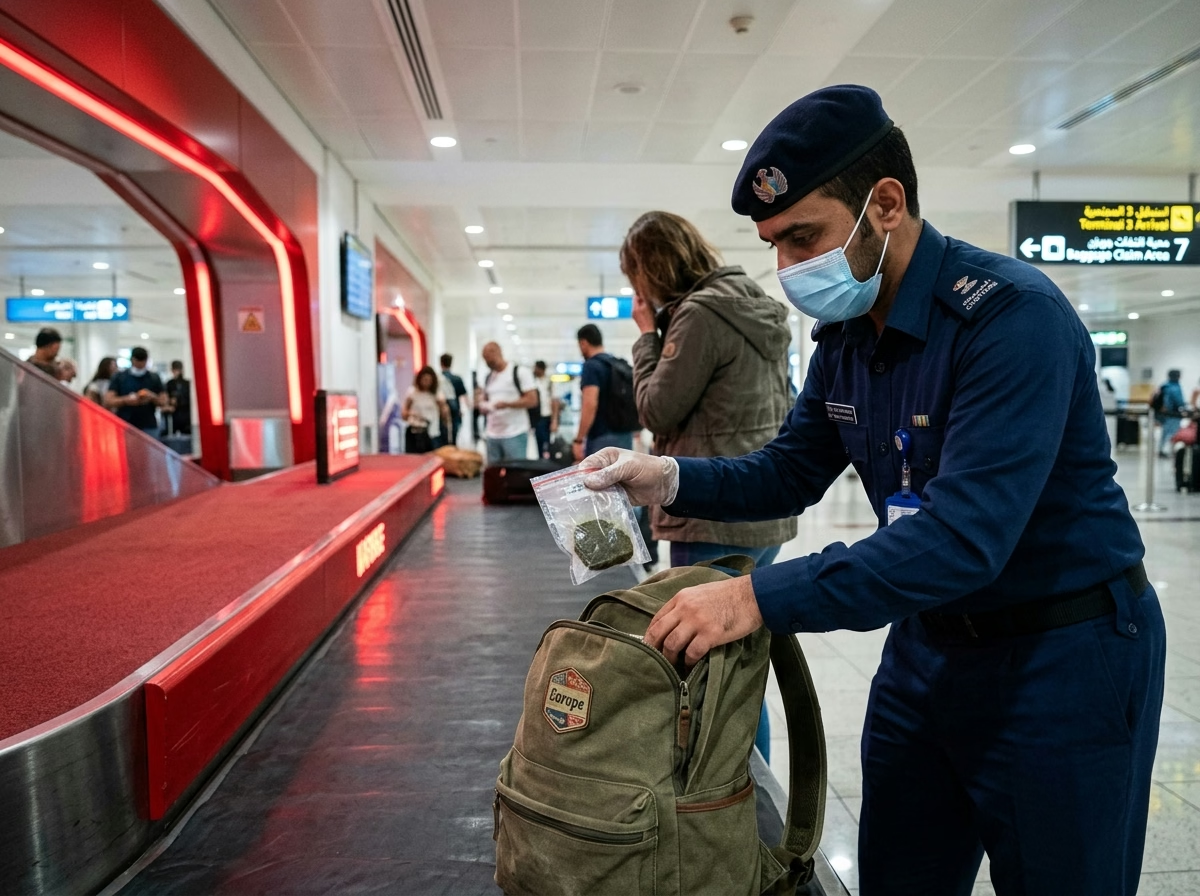
- Community and Legislative Measures: Dubai’s laws impose strict penalties for serious crimes (drugs, violence, trafficking). Police regularly collaborate with communities and global partners, and the legal system processes international warrants efficiently. In every recent high-profile arrest, Dubai authorities adhered fully to legal procedures (Ministry of Interior and Public Prosecution coordination, INTERPOL red notices, judicial review). This shows that any suspect who sets foot in Dubai is subject to UAE law.
Overall, Dubai’s public-safety infrastructure – from smart cameras to digital police services – and robust rule-of-law framework help keep crime extremely low. The focus on technology and transparency in policing is repeatedly noted by international observers.
International Crime Crackdowns
Dubai Police has repeatedly worked with foreign law enforcement to dismantle global criminal networks. Recent examples include:
- Operation “Haris” (Dec 2025): In collaboration with Europol, Serbia, and Spain, Dubai Police arrested Marko Đorđević, alleged leader of the violent Balkan “Vraçarci” (Witchcrafters) gang. Đorđević was wanted in multiple countries and had been residing in Dubai when Serbian investigators identified him after a Belgrade murder. Acting on an Interpol Red Notice Dubai, authorities swiftly detained him under UAE legal procedures. Europol praised Dubai Police’s role – highlighting their technical expertise, rapid response, and cooperation – as decisive in dismantling the gang.
- Belgian Fugitive Ring (July 2025): Dubai Police tracked down and extradited three Belgian nationals wanted by European authorities for cross-border crimes (drug trafficking, robbery, human trafficking, etc.). Each was on Interpol/Europol wanted lists with Belgian arrest warrants. After arrest in Dubai, all legal and judicial requirements were fulfilled before handing them over to Belgium. Dubai authorities noted this operation showcased “close coordination with international law enforcement” and reinforced global security cooperation.
- Extraditions to France (2025): In a series of cases, Dubai Police arrested and extradited ten individuals to France in 2025 alone. The suspects were implicated in serious offenses (fraud, drug trafficking, organized crime, even murder and arms trafficking). After INTERPOL Red Notices, Dubai’s investigative teams used advanced data analysis to locate the fugitives, then formally processed the extradition from Dubai under UAE law. The Interior Ministry emphasized that these handovers reflect the UAE’s “commitment to strengthening cooperation and collaboration with law enforcement agencies worldwide,” ultimately to “enhance community safety” everywhere.
- Other Joint Operations: Dubai routinely leads or participates in cross-border operations. For example, Dubai Police intelligence exchanges with Spain have resulted in dozens of arrests and extraditions of Spain’s most wanted. In 2021 Dubai also arrested international drug lords from Europe and the US. In all cases, Dubai forces acted under international frameworks (Europol liaison, EUROJUST, INTERPOL red notices) and kept all actions “in full compliance with UAE legal procedures”.
In every operation, partners have publicly commended Dubai’s efforts. European agencies specifically highlighted how Dubai law enforcement's intelligence-sharing, technical capability, and professionalism made the difference in catching fugitives. For instance, Europol noted that the success of Operation Haris “reflected the UAE’s commitment to working closely with law enforcement agencies around the world”. These endorsements show that Dubai is seen as a key global partner against organized crime, not a loophole for criminals to exploit.
Advanced Security Collaboration
Beyond individual cases, Dubai’s approach is systematic. The city’s legal system honors extradition requests and mutual legal assistance (as seen in the Belgian and French cases). Interpol Red Notice Dubai alerts trigger immediate follow-up: as one official put it, teams “apprehended all wanted individuals shortly after receiving the red notices” using precise tracking tech. Meanwhile, traditional policing remains strong – Dubai has one of the highest police-per-capita ratios, frequent patrols, and public-safety campaigns (e.g. anti-drug, traffic safety, child protection).
Dubai also invests in preventive security: its strict laws and vigilant enforcement deter criminal activity. By consistently honoring international arrest warrants and applying harsh penalties for terrorism and trafficking, Dubai signals that no fugitive is beyond reach. Criminals know that hiding assets or buying luxury property (a common way fugitives maintain status here) won’t shield them from arrest.
Conclusion: A Secure Global City
Contrary to the “safe haven” myth, Dubai has shown time and again that it enforces the law against anyone – local or foreign. Notable fugitives who tried to escape to Dubai have been apprehended and extradited thanks to vigorous police work and international cooperation. The UAE’s top global safety rankings (with the lowest crime rate on Earth) reflect these efforts. As a Dubai Police commander summarized, their successes “uphold the rule of law and support international partners in disrupting cross-border criminal organisations”.
In short, Dubai is a haven – but for law-abiding citizens and businesses. Criminals beware: Dubai’s world-class police and security systems will catch you, no matter how far you think you can run.
Read more
- Dress Code in Dubai: What Can You Wear Where?
- Alcohol in Dubai: Current Rules 2026
- Dubai Visa Law Update: Dubai Links Visa Renewal to Fines in New System
- Converting a German Driving Licence in Dubai
- Navigating UAE Labour Law: A Guide for New Employers on Contracts, Visas, and WPS
- Germany-UAE Double Taxation Agreement Explained Simply
- Inheritance in Dubai: What Happens to Assets After Death?
- Marriage in Dubai as a German: Legally Recognised in Germany