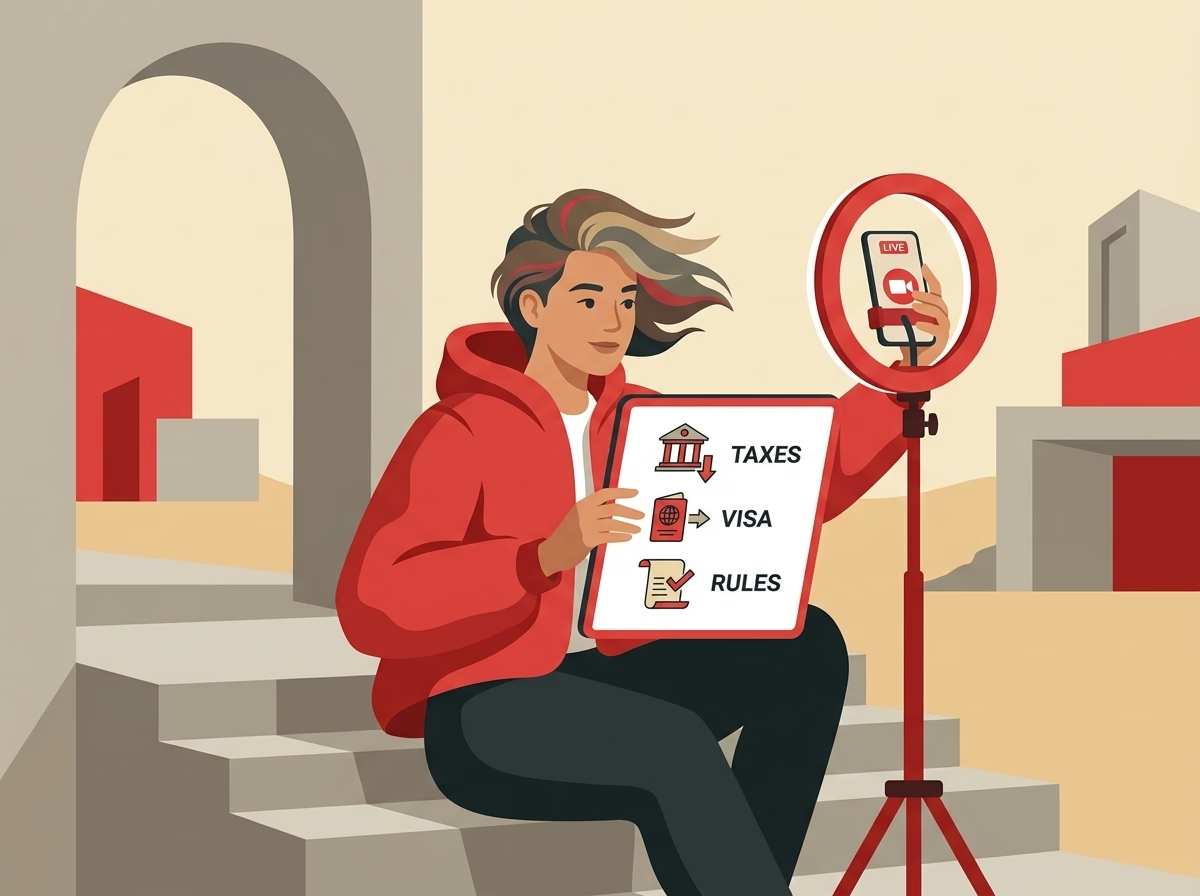
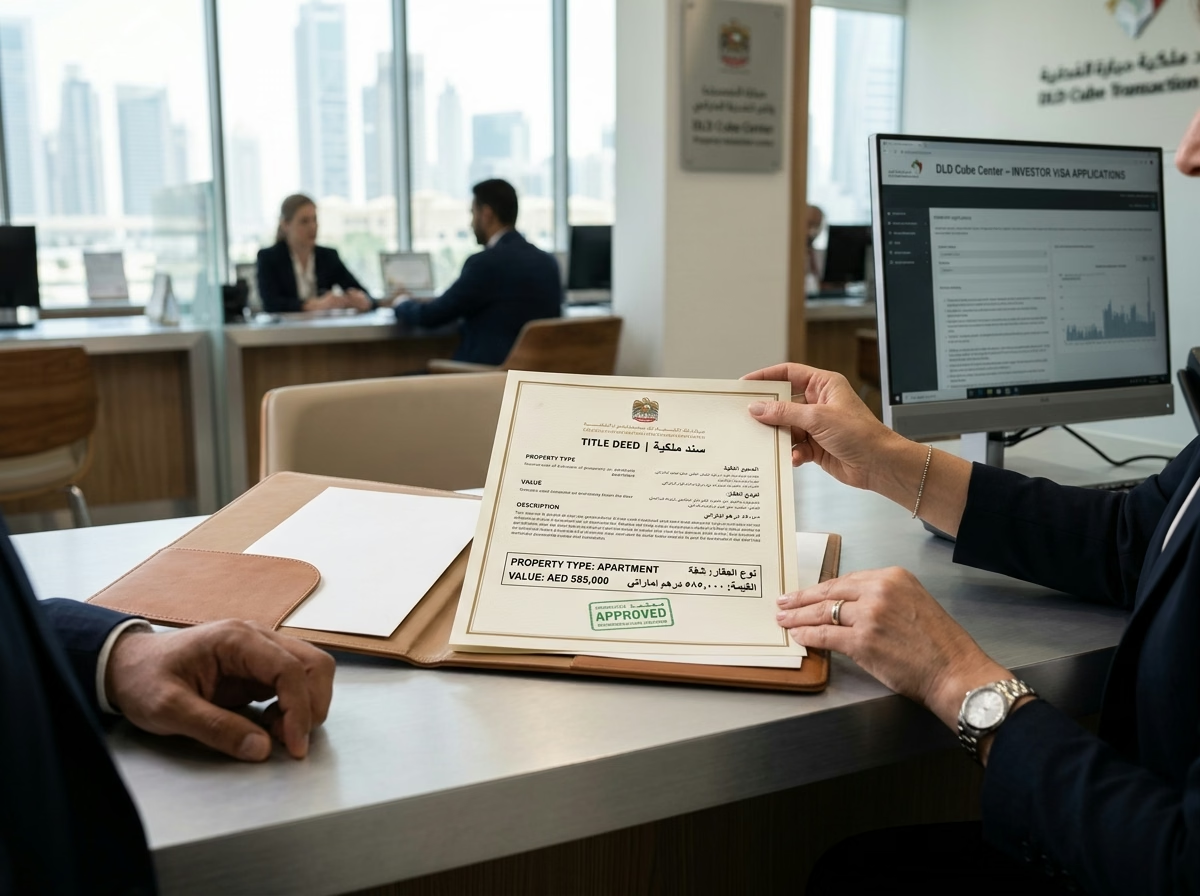
The 1-year Virtual Working Programme, the 5-year Green Visa, and the in-country Freelance Permit are not the same product, and choosing the right one is the difference between a clean move and a wasted application.
If you work remotely for a foreign company and you are thinking about basing yourself in Dubai, the Dubai remote work visa is almost certainly the right starting point. Not the freelance permit. Not a tourist visa stretched across an Air-conditioned summer. Most of the digital-nomad content circulating on social media confuses three completely separate pathways into UAE residency, and people end up applying for the wrong one. This guide separates them cleanly, walks through the 2026 conditions, costs, and tax intersections, and helps you decide which path fits your actual situation.
Three pathways for remote workers, three different logics
Which Dubai pathway fits you?
A 30-second decision tree for remote workers
You keep a German, British, or US employer and work from Dubai.
Virtual Working Programme
1 year, USD 287 application fee, USD 3,500 monthly salary minimum, foreign payslips required.
Agency, consulting, or e-commerce. You want 5 years without renewals.
Green Visa
5 years, self-sponsored, AED 360,000 annual income for 2 years, or AED 1M Dubai real estate.
You want to invoice UAE-based clients in AED.
Freelance Permit
1 to 3 years, Free Zone issued (TECOM, twofour54, RAKEZ), AED 7,500 to AED 25,000.
Pick once. Switching pathways mid-application means starting over.
Dubai offers three distinct routes for someone whose income comes from a screen rather than a local UAE office. They look similar from the outside, but the rules, costs, and eligibility are very different.
- Virtual Working Programme (VWP): for foreign-employed remote workers. You keep your German, British, French, or American employer; you simply live and work from Dubai. This is the actual Dubai remote work visa.
- Green Visa (self-sponsored, 5 years): for self-employed people, freelancers, or skilled professionals who want long-term stability without yearly renewals.
- Freelance Permit: for those who want to invoice UAE clients from inside the UAE. This is a different beast, and it has its own complete guide to the Dubai Freelance Visa.
The decision tree is simple once the three are separated:
- Foreign employer pays you in EUR, GBP, or USD into a foreign account, you want to live in Dubai → VWP .
- You are your own boss (agency, consulting practice, e-commerce store) and want a 5-year residence without sponsor friction → Green Visa .
- You want to take on UAE-based clients and invoice in AED → Freelance Permit .
Mixing these up costs time and money. We see applicants reach the medical-test stage of the wrong permit before realising the mismatch.
Pathway 1: Virtual Working Programme (the actual Dubai remote work visa)
The Virtual Working Programme was launched by the Dubai Government in March 2021 specifically for foreign-employed remote workers. The official portal name is "Virtual Working Programme"; in practice everyone calls it the Dubai remote work visa or, less precisely, the Dubai digital nomad visa. For most people researching a Dubai digital nomad lifestyle in 2026, this is the entry point. It is what you want if your employer sits in Berlin, Munich, London, or San Francisco and you do not need to change anything about your employment contract.
Eligibility (2026)
- Valid passport with at least 6 months remaining
- Employment contract with a foreign company, valid for at least 1 year from the date of application
- Minimum monthly salary of USD 3,500, evidenced by 3 months of recent payslips, or USD 5,000 plus 12 months of payslips for some self-employed structures
- Health insurance with valid UAE coverage
- Last month's payslip and 3 months of personal bank statements
Costs (2026)
- Application fee: USD 287 (paid online via the official Dubai Government portal)
- Medical fitness test: approximately AED 320 (USD 87)
- Emirates ID issuance: approximately AED 370 (USD 100)
- Health insurance: AED 1,500 to AED 4,000 per year depending on cover
- Visa stamping and biometrics: approximately AED 500 (USD 136)
The often-quoted "USD 287 for a Dubai nomad visa" figure is the application fee only. Real all-in cost for a single applicant lands between USD 800 and USD 1,400 in the first year, before rent, deposits, or relocation logistics. Anyone telling you the visa costs USD 200 with "no rules" is selling something.
Duration and renewal
The VWP is valid for 1 year and is renewable for further 1-year periods provided the employment, salary, and health-cover conditions are still met.
Pathway 2: Green Visa (self-sponsored, 5 years)
The Green Visa is a 5-year residence permit introduced in 2022 for self-employed people, freelancers, and high-skilled professionals who want stability without yearly renewals or sponsor dependency. It is the right path for an agency owner, an established consultant, an e-commerce founder, or a senior professional with a track record.
There are three tracks under the Green Visa umbrella. For digital nomads the relevant ones are the freelancer/self-employed track and the skilled professional track.
Freelancer / self-employed track (2026)
- Bachelor's degree or specialised diploma
- Proof of self-employment (Ministry of Human Resources permit or equivalent)
- Annual income of at least AED 360,000 (approximately USD 98,000) for each of the previous two years, evidenced by tax returns, bank statements, and contracts
- Or, alternatively, real-estate investment in Dubai of at least AED 1,000,000 (USD 272,000)
Skilled professional track (2026)
- Bachelor's degree
- Employment contract with monthly salary of at least AED 15,000 (USD 4,084)
- Occupation classification level 1, 2, or 3 (UAE Ministry of Human Resources classification)
Cost (2026)
Government fees for Green Visa issuance and stamping land between AED 2,300 and AED 4,000 (USD 626 to USD 1,089) before medical, Emirates ID, and insurance. Renewal at year five is straightforward provided income or asset conditions still hold.
The Green Visa is the right choice if you have already proven the income and you want to stop dealing with the visa office every 12 months. The 5-year horizon also makes opening UAE bank accounts, signing 2-year apartment leases, and bringing dependants under sponsorship dramatically easier.
Pathway 3: Freelance Permit (in-country freelance)
If your business model involves taking on UAE clients and invoicing in AED, you do not want the VWP. You want a Freelance Permit issued by a UAE Free Zone such as TECOM Dubai Internet City, twofour54 Abu Dhabi, Fujairah Creative City, or Ras Al Khaimah Economic Zone (RAKEZ). The permit ranges from 1 to 3 years, costs from AED 7,500 to AED 25,000 depending on Free Zone and trade activity, and entitles the holder to a freelance trade name, residence visa, Emirates ID, and the right to issue VAT-compliant invoices to UAE customers.
This pathway has its own dedicated deep dive, including the Free Zone comparison and the cost breakdown by activity. Read the full Dubai Freelance Visa guide for self-employment in the UAE before deciding between the Freelance Permit and the Green Visa.
Three-pathway comparison at a glance
Three pathways, two dimensions
Year-one cost and residence duration, side by side
All-in cost in year one for a single applicant. Excludes rent, school fees, relocation logistics.
| Pathway | Duration | Cost (year 1, all-in) | Income / asset threshold | Sponsor required |
|---|---|---|---|---|
| Virtual Working Programme | 1 year, renewable | USD 800 to USD 1,400 | USD 3,500/mo from foreign employer | No (foreign employer is implied sponsor) |
| Green Visa | 5 years, renewable | USD 2,000 to USD 3,500 | AED 360k/yr or AED 1M assets | No (self-sponsored) |
| Freelance Permit | 1 to 3 years | USD 2,500 to USD 9,000 | Free Zone-specific, no salary minimum | No (Free Zone is sponsor) |
Tax: 183 days, the Germany-UAE DBA, and German employer payroll
This is where most digital-nomad guides go silent and where the real money is at stake.
The 183-day rule
Germany taxes residents on worldwide income. The first question for a German remote worker moving to Dubai is whether you remain a German tax resident. The two anchors are habitual residence (Wohnsitz) and the 183-day rule. If you spend more than 183 days in Germany in a calendar year and keep a home there, the Finanzamt will treat you as a German tax resident regardless of your Dubai paperwork. The trip-and-travel nomad model where you spend 4 months in Berlin every summer can re-trigger German tax residence even with a perfectly valid Dubai VWP.
Germany-UAE DBA (Doppelbesteuerungsabkommen)
The Germany-UAE double-taxation treaty allocates taxing rights based on where the work is physically performed and where the recipient is resident. The current DBA does not contain a comprehensive non-discrimination clause for personal income, which means proper exit planning, including deregistration in Germany (Abmeldung), severing habitual-residence anchors, and maintaining clean physical-presence records, matters more than for, say, Germany-Switzerland.
German employer payroll continuity (the trap)
If you keep your German employment contract and move to Dubai under the VWP, your employer typically still has to run you through German payroll because the contract is governed by German law and your previous tax residence triggered withholding obligations. The clean version requires either (a) the German employer to formally outsource the role to a UAE entity (Employer of Record or local subsidiary), or (b) the employee to switch to a foreign-payroll arrangement, or (c) the employee to set up a UAE company that contracts with the German employer. Each route has tax and labour-law consequences that need a tax adviser before signing anything. None of this is legal advice.
For the broader DACH-tax intersection, including the German exit tax 2026 changes for shareholders moving to Dubai, read the full Wegzugsteuer article.
Setup sequence after your visa is issued
Once your residence visa is stamped and your Emirates ID arrives, three things happen quickly.
- Health insurance. UAE law requires valid health cover. Pick a local plan that covers Dubai hospitals; expat-only travel insurance is not accepted at residency renewal.
- Bank account. Some retail banks are reluctant with 1-year VWP holders because the residency horizon is short. Digital-first options such as WIO, Mashreq Neo, or DIB digital channels typically open accounts in 3 to 7 days. The full step-by-step guide to opening a Dubai bank account as an expat covers documentation, minimum balances, and common rejection reasons.
- Apartment lease. Most landlords require an Emirates ID and a security deposit of 5 percent of annual rent. Dubai Marina, JBR, and Downtown have the largest expat-and-DACH community footprint and the densest coworking infrastructure.
The Dubai practical layer: coworking, internet, time zones, community
Dubai's infrastructure for remote workers is genuinely excellent in 2026. Here is what matters in practice.
Coworking spaces
The serious options for full-time remote workers are AstroLabs (DTec, Dubai Internet City), A4 Space (Alserkal Avenue, Al Quoz), NEST (DIFC), Letswork (multiple locations including hotels), and the AstroLabs Loft on Sheikh Zayed Road. Most run AED 1,200 to AED 2,500 per month for a hot desk, AED 2,500 to AED 5,000 for a dedicated desk. Day passes start at AED 100. Most have proper meeting rooms, fast WiFi, and a community calendar.
Internet
Fibre speeds in Dubai apartment districts are 250 Mbps to 1,000 Mbps via du or Etisalat. Mobile 5G coverage is excellent across the city. Reliability is high. The bottleneck is rarely the connection; it is the time zone fit with your team.
Time zone
UAE Standard Time is GMT+4. That is 2 hours ahead of CET (Berlin, Frankfurt, Vienna, Zurich) in winter and 3 hours ahead in summer. For a German employer working 9 to 17, your effective Dubai workday is 11 to 19. Workable. Pacific-time teams are tougher, with a 12-hour offset that means evening calls or pre-dawn standups.
DACH community
Dubai Marina, JBR, Downtown, and Business Bay carry the largest German-speaking expat communities in the city. There are German-language schools, German bakeries, monthly DACH founder meetups, and a substantial Austrian and Swiss network around the Marina. The cultural friction for someone moving from Munich or Hamburg is low.
What digital-nomad influencer content leaves out
A lot of the "Dubai nomad visa, USD 200, no rules" content circulating on Instagram and TikTok skips the parts that actually decide whether the move works. To be clear:
- The USD 287 fee is the application fee for the VWP. The all-in first-year cost is roughly four to five times that.
- Income evidence is not a formality. Banks and the visa portal compare bank statements line-by-line against payslips, and inconsistent self-employment income gets flagged.
- Health insurance is mandatory. Travel insurance is not accepted at renewal.
- The German Finanzamt does not care that you have a Dubai Emirates ID if you still have a Munich apartment and your kids are in school in Germany.
- The Freelance Permit is not the same as the VWP, and applying for the wrong one is the most common mistake we see.
If your sources are influencers, double-check the rules on the official Dubai Government portal or with an advisor before signing anything.