From no minimum (sole owner) to AED 2,000,000 plus, four investor-visa doors at four price points. The threshold ladder, updated for late-April 2026.
The first question everyone asks about the investor visa Dubai is the same: from what amount? The answer changed in late April 2026. The lowest door now has no minimum property value at all for sole owners after the Dubai Land Department removed the previous AED 750,000 floor on its Cube Center platform; joint owners each need an AED 400,000 stake. Above that sit three further doors at AED 1,000,000, AED 2,000,000, and the Golden Visa thresholds. Which tier fits depends on what you invest in, where, and how long the residency needs to last.
This guide maps every threshold active in 2026, the process for each route, the issues DACH investors face (Wegzugsbesteuerung, CFC anti-avoidance, the DBA Deutschland-VAE), and the mistakes we see most often.
The four doors: a threshold ladder
The Investor Visa Dubai threshold ladder
Four doors. Since late April 2026, Tier 1 has no minimum for sole owners.
There are four entry points to a UAE investor visa: three through capital investment and one through retirement-linked investment. The numbers below are regulatory minimums; the all-in cost is higher once government fees, medical, Emirates ID, and Dubai Land Department charges are factored in.
| Tier | Visa | Threshold | Duration | Anchor |
|---|---|---|---|---|
| 1 | Property Investor Visa | Any value (sole owner) / AED 400,000 each (joint) | 2 years | Dubai Land Department |
| 2 | Golden Visa (property route) | AED 2,000,000 in property | 10 years | ICP / GDRFA |
| 3 | Golden Visa (capital / business route) | AED 2,000,000 deposit, license, or qualifying business stake | 10 years | ICP / GDRFA |
| 4 | Retirement Investor Visa | AED 1,000,000 property OR AED 1,000,000 savings, plus AED 60,000 monthly income, age 55+ | 5 years renewable | GDRFA |
Two further structures behave like investor visas. A partner / shareholder visa lets a UAE company sponsor a partner with a paid-up share of typically AED 50,000 to AED 100,000. It appears in every "investor visa Dubai" search because it is what real founders actually use. A freelance / sole-establishment route is cheaper and faster than any of the four above and covers many readers who think they need an investor visa but do not.
Tier 1: Property Investor Visa (2-year residency, no minimum for sole owners)
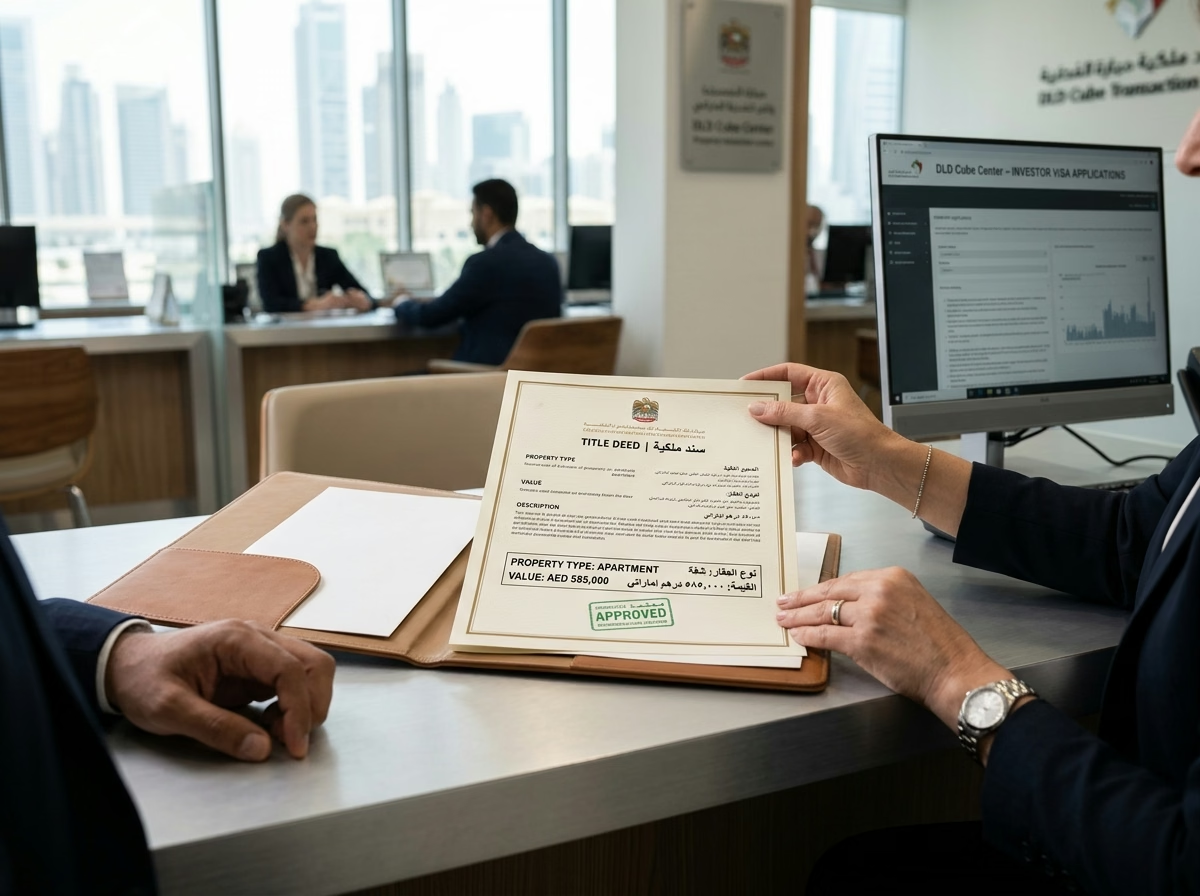
The lowest-threshold route, and the one most readers genuinely qualify for. Since the Dubai Land Department updated its Cube Center platform in late April 2026, the AED 750,000 floor has been removed: any property value qualifies for the 2-year renewable Property Investor Visa as long as you are the sole owner. Joint owners each need a stake of at least AED 400,000. Applications run through DLD Taskeen and are issued by GDRFA.
- No minimum value for sole owners. A studio at AED 400,000 or a townhouse at AED 5 million both qualify equally for the 2-year visa, provided the title deed is in your personal name.
- Joint ownership: AED 400,000 stake per co-owner. Each name on the title deed must represent at least AED 400,000 of value.
- Property must be ready, not off-plan. Off-plan units do not count until handover and title-deed issuance.
- Mortgaged properties count only on the equity portion paid down. AED 150,000 paid-in on an 80% financed unit does not unlock this visa.
- Renewable indefinitely as long as you keep holding qualifying property.
The application runs through the Dubai Land Department e-services and the GDRFA. Our buying property in Dubai as a German deep-dive walks through the title-deed process, AED-to-EUR exchange-rate timing, and DLD transfer fees.
Step-by-step
- Buy the ready property through a registered broker; complete title transfer at the DLD.
- Open the DLD investor profile online and link the title deed.
- Apply for the entry permit (e-visa) through DLD.
- Status change inside the UAE : convert the entry permit into a residence visa.
- Medical fitness test at an approved centre.
- Emirates ID biometrics and application.
- Visa stamp issued ; residence active for 2 years.
End-to-end: 4 to 8 weeks if the property purchase is already complete.
Tier 2: Golden Visa via property at AED 2,000,000 (10 years)
AED 2,000,000 in real estate unlocks 10 years of residency that does not require continuous physical presence. Our Dubai Golden Visa 10 Years: Who Qualifies in 2026? handles the full eligibility matrix (investors, entrepreneurs, specialists, creatives), file requirements, sponsor rules, and renewal mechanics. Here we keep the focus on what an investor specifically needs.
Compact version: AED 2,000,000 in property at Dubai Land Department market value (not contract price) qualifies. Off-plan can count if the developer is approved and the down payment plus paid instalments cross AED 2,000,000. Mortgages are treated more leniently than Tier 1: a property of AED 2,000,000+ counts even if partly financed, provided the bank issues a no-objection certificate.
Tier 3: Golden Visa via capital, deposit, or business stake (AED 2,000,000)
Two non-property paths exist if your capital is not in real estate.
Path A: Bank deposit. A non-callable AED 2,000,000 deposit in a UAE-licensed bank for a minimum 24-month term, in your individual name and freely identifiable. After 24 months you can withdraw without losing the visa; renewing later requires re-evidencing capital.
Path B: Qualifying business or shareholder stake. A founder, partner, or shareholder in a UAE-licensed company with a paid-up share of at least AED 2,000,000 qualifies, provided the entity is active, files audited statements, and is registered with a recognised authority (DET, DMCC, DIFC, ADGM, IFZA, etc.). Below that level, the partner visa (above) remains the practical option.
A less-publicised structure for entrepreneurs is a Ministry of Economy endorsement based on a registered project of approved value, which can substitute for the deposit or share-capital threshold but requires more paperwork.
Step-by-step (Tier 2 / Tier 3)
- Establish the qualifying basis (property, deposit, or business).
- Issue supporting documentation : title deed, bank letter, or commercial license + share certificate + audited financials.
- Apply for the Golden Visa nomination through ICP, GDRFA Dubai, or a free-zone authority.
- Entry permit or status change , then medical and Emirates ID biometrics.
- Issue 10-year visa .
Realistic timeline: 6 to 12 weeks if the qualifying basis is already in place.
Tier 4: Retirement Investor Visa (5-year, age 55+)
The retirement route blends investment and income criteria. You qualify at age 55+ and meet one of the following:
- Own AED 1,000,000+ in UAE property; or
- Hold AED 1,000,000+ in financial savings; or
- Earn AED 60,000+ per month from a verifiable source (pension, rental, dividends).
DACH retirees often combine routes: a Dubai apartment used a few months a year, a savings buffer, and a German pension stream. The visa renews in 5-year increments. Plan the medical-cover budget before relocating; private health insurance for residents over 70 is several multiples of the EU equivalent.
Partner / shareholder visas: the actual founder route
Which investor-visa door fits you?
Read down. The first answer that matches you is your starting point.
Almost every founder we work with at the AED 50,000 to AED 1,500,000 capital range uses a partner / investor / shareholder visa sponsored through their UAE company, not a property visa or Golden Visa. The route is faster, cheaper, and does not require AED 2,000,000 in real estate. The threshold is the company's registered share-capital structure, not a personal asset test. Mainland uses ICP / DET; free zones use their authority. Duration is typically 2 years (mainland) or 2 to 3 years (free zones), renewable.
The line between "investor visa Dubai" and "founder visa" blurs here. If your goal is to operate a company in Dubai, the partner-visa route is normally right. If your goal is residency without active operations, one of the four passive tiers fits better. Freelancers who do not deploy capital should look at the freelance / sole-establishment route.
German-specific considerations: Wegzugsbesteuerung, CFC, DBA
For DACH investors, the visa sits upstream of three German tax issues.
1. Wegzugsbesteuerung (§6 AStG). If you have held shares of more than 1% in a German Kapitalgesellschaft for at least one year, departing Germany triggers a deemed-disposal at fair market value, with capital-gains tax on the unrealised gain. The rules tightened in 2025 and 2026. The timing of visa issuance, deregistration, and beneficial ownership all matter. Read German Exit Tax 2026 before booking the medical test.
2. CFC / Hinzurechnungsbesteuerung. If your Dubai company qualifies as a foreign passive-income vehicle and you remain a German tax resident even briefly, §§7-14 AStG can attribute the company's passive income to you in Germany, regardless of UAE treatment. The visa alone does not break German tax residency.
3. DBA Deutschland-VAE. The treaty does not exempt all classes of return. Rental income and capital gains from Dubai property are allocated to UAE (effectively zero personal income tax). Dividends from a Dubai company to a German tax resident, however, fall under the dividend article and remain taxable in Germany at the Abgeltungsteuer rate.
The compact rule: the visa is not the tax plan. The visa enables the residency that enables the tax plan. Treat them as two separate workstreams.
Common mistakes we see
Tourist visa for property scouting. Buying property as a tourist is legal, but a tourist visa cannot convert into the investor permit. You leave, then re-enter on the investor entry permit.
Off-plan on a payment plan. Off-plan does not count toward the threshold until handover and title-deed issuance, even if 60% has been paid. First-time investors most often assume contract value equals visa-eligible value.
Paying agency fees for things ICA does directly. Services that immigration agencies charge AED 2,000 to AED 5,000 for are often AED 100 to AED 200 self-service flows on ICP / GDRFA portals (visa renewals, address updates, Emirates ID re-prints).
Ignoring renewal cashflow and KYC. UAE banks must KYC the source of funds for any Tier 3-sized deposit; EU-based investors face anti-money-laundering checks on both ends. Build 30 to 60 days into the timeline. At renewal, a 2-year property route requires you to still hold qualifying property; a 10-year Golden Visa requires re-evidencing the qualifying basis.
Honest cons
A residency-by-investment path is a legitimate Dubai product, but the marketing pushes a particular emotional narrative. Three things we tell every applicant.
First, buying Dubai property is not always the cheapest path to UAE residency, even with the new no-minimum rule . A freelance permit, a partner visa via an LLC at AED 50,000 to AED 100,000 share capital, or an employment visa all clear residency at far lower capital exposure than buying any apartment. The Property route makes sense if you genuinely want Dubai property; less so if the residency is the goal and the property is forced to fit.
Second, the cashflow profile of low-value Dubai property is not glamorous . Service charges, DLD fees, rental agency commissions, and maintenance on first-handover units turn the headline gross yield of 6 to 8% into a 3 to 5% net. A studio bought purely to clear the visa threshold rarely covers its own costs net of fees. The Dubai Real Estate Boom 2026 analysis linked below has the numbers.
Third, the visa is the start, not the end . UAE residency does not equal UAE tax residency; UAE tax residency does not break German tax residency by itself; breaking German tax residency does not eliminate Wegzugsbesteuerung. Each step needs its own paperwork.
Contact START for a free consultation; we will map your situation across the four tiers and the partner-visa route, and tell you which door fits.
Read more
- Dubai Golden Visa 10 Years: Who Qualifies in 2026?
- Buying Property in Dubai as a German: Complete Guide
- German Exit Tax 2026: Why Moving to Dubai Just Got More Expensive
- Dubai Real Estate Boom 2026: Is Now Still a Good Time to Buy?
- Dubai Freelance Visa: Your Complete Guide to Self-Employment in the UAE