Choosing between a free zone vs mainland Dubai company is the single biggest decision a German entrepreneur makes when relocating to the UAE. Get it right and you save tens of thousands of dirhams a year, lock in 0% corporate tax through Qualifying Free Zone Person status, and unlock the right market. Get it wrong and you pay 9% on profits you could have shielded, lose access to the UAE consumer market, or sit on a license that does not match what you actually sell.
Here is the short answer: a free zone Dubai company wins for online businesses, e-commerce, consulting that bills international or DACH clients, holding companies, and any setup where you do NOT need to invoice the UAE retail market directly. A mainland Dubai company wins when you sell to UAE consumers, supply UAE government contracts, run a physical retail or restaurant location, or import and distribute goods inside the country. Both options now allow 100% foreign ownership, both apply the same 9% UAE corporate tax above AED 375,000 profit, and both are open to Germans without a local sponsor. The differences sit in market access, banking, visa quotas, costs, and whether you can claim the 0% Qualifying Free Zone Person rate.
This pillar guide walks every German founder through the free zone vs mainland Dubai decision the way our advisors do it in a free consultation.
What "Free Zone" and "Mainland" Actually Mean in Dubai
Free Zone vs Mainland Dubai: Decision Tree
Answer three questions to find your jurisdiction
Before comparing, both terms need a precise definition. Confusion here drives most of the bad license decisions we see at consultation.
Free Zone Companies in Dubai
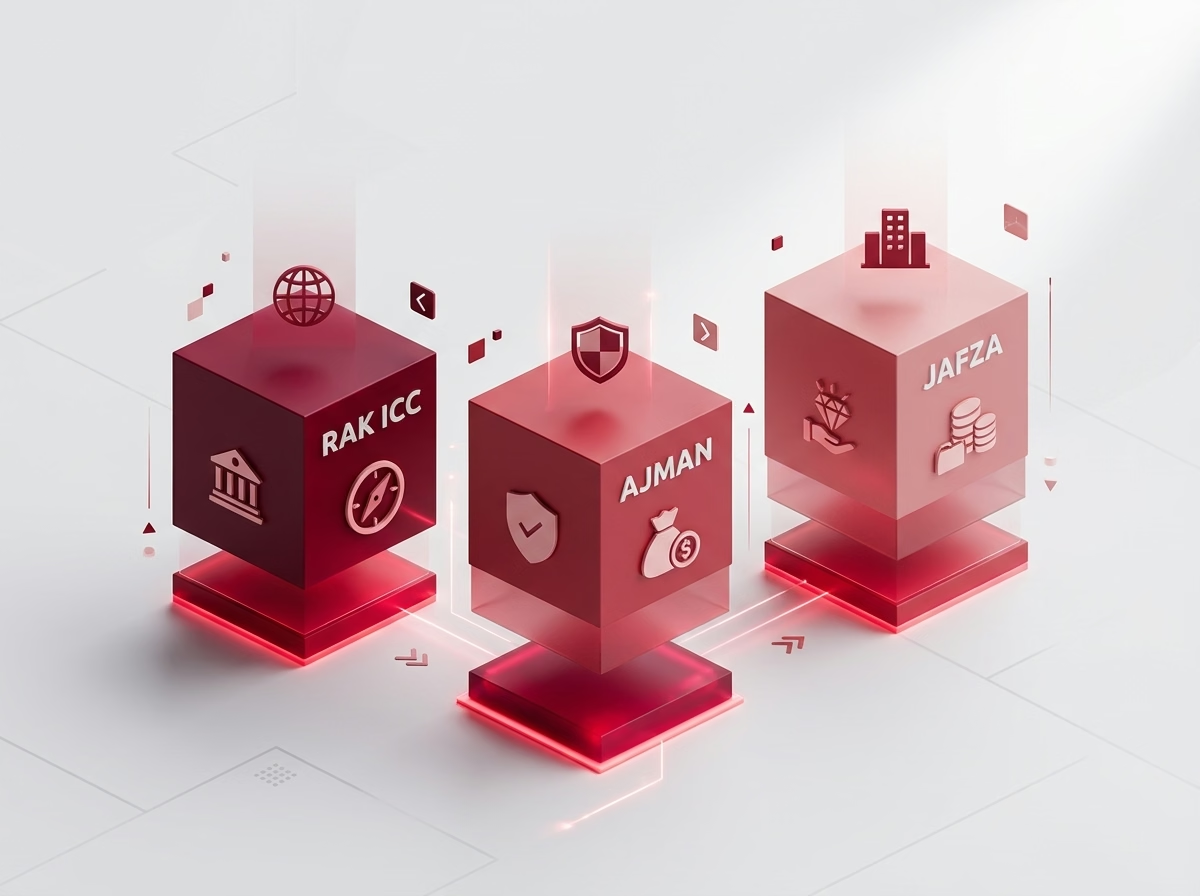
A free zone is a designated economic area inside the UAE that operates under its own legal and licensing authority, separate from the federal Department of Economic Development. Each free zone (DMCC, IFZA, Meydan, ADGM, DIFC, Dubai Internet City, JAFZA, RAKEZ and roughly 30 others across the UAE) has its own price list, allowed activity catalogue, visa quotas, and physical campus.
Key features of a free zone Dubai company:
- 100% foreign ownership (always, never required a local partner)
- 0% personal income tax for the owner
- 9% UAE corporate tax above AED 375,000 annual profit, OR 0% if you qualify for Qualifying Free Zone Person (QFZP) status
- Restricted to operating WITHIN the same free zone or INTERNATIONALLY. A free zone company CANNOT directly invoice or trade with the UAE mainland market without going through a local distributor, a branch, or a dual license.
- Often sold as a package: license + flexi-desk + 1 to 6 visa allocations + bank account introduction
- Approximate base license cost: AED 12,500 to 25,000 per year depending on free zone authority and activity (as of 2026)
Mainland Companies in Dubai
A mainland Dubai company (also called an "onshore" or "DED" company) is licensed by the Department of Economy and Tourism of the relevant emirate. In Dubai that is the Department of Economic Development (DED). Since the 2020 Federal Decree-Law 26/2020 commercial companies reform, the requirement to have a 51% UAE national shareholder was removed for most commercial activities.
Key features of a mainland Dubai company:
- 100% foreign ownership for the vast majority of activities (the activity list of restricted "strategic impact" sectors is narrow and mostly covers oil, defence, and certain banking activities)
- 0% personal income tax for the owner
- 9% UAE corporate tax above AED 375,000 annual profit (no QFZP route. Mainland companies cannot claim 0%)
- FULL access to the UAE mainland market: you can invoice UAE consumers, sell to UAE businesses, bid on UAE government tenders, open retail or restaurants, and trade physical goods imported into the country
- Requires a physical office with a registered Ejari tenancy contract (no full virtual or flexi-desk option in most cases)
- Visa quota tied to office size, roughly one visa per 9 sqm of registered office space
- Approximate base license cost: AED 15,000 to 30,000 per year, plus DED fees, Ejari office rental, and immigration card fees (as of 2026)
Free Zone vs Mainland Dubai: The Headline Comparison
| Factor | Free Zone Dubai | Mainland Dubai |
|---|---|---|
| Foreign ownership | 100% | 100% (most activities) |
| Corporate tax | 9% above AED 375k, or 0% with QFZP status | 9% above AED 375k, no 0% route |
| Personal income tax | 0% | 0% |
| Sell to UAE mainland market | Indirect only (distributor or branch) | Yes, fully |
| UAE government contracts | No (in most cases) | Yes |
| Physical retail or restaurant | No | Yes |
| Office requirement | Flexi-desk allowed in many free zones | Physical office with Ejari mandatory |
| Visa quota | Bundled package, often 1 to 6 | Tied to office sqm |
| Bank account | Sometimes harder, depends on activity | Generally easier |
| Approx. annual license cost | AED 12,500 to 25,000 | AED 15,000 to 30,000 plus office |
| Best for | Online, consulting (international clients), holding, SaaS | UAE retail, F&B, government contracts, importing |
When a Free Zone Dubai Company Wins
A free zone Dubai company is the right answer for most relocating German entrepreneurs. The reason is structural: most Germans moving to Dubai are bringing an online business, an international consulting practice, a SaaS product, or a portfolio of investments. None of these need to invoice the UAE consumer market.
Use cases where a Freezone Dubai setup wins clearly
- E-commerce stores serving Europe, US, or international markets (DMCC, IFZA, Meydan are common picks)
- B2B consulting and coaching billing DACH clients
- SaaS businesses with international subscribers
- Marketing agencies serving international clients
- Holding companies for investments, real estate, or intellectual property
- Crypto and Web3 businesses (VARA-regulated activities sit inside Dubai's free-zone framework)
- Trading companies importing to Jebel Ali (JAFZA) and re-exporting internationally
- Influencers and content creators monetising via international platforms
The Qualifying Free Zone Person (QFZP) advantage
The single biggest selling point of a free zone Dubai company is the Qualifying Free Zone Person (QFZP) status, which preserves the historic 0% corporate tax rate that put the UAE on the international map.
To qualify for QFZP and pay 0% on qualifying income:
- Be incorporated in a designated UAE free zone (most major Dubai free zones qualify)
- Maintain adequate substance in the UAE: real office, real staff, real operating expenditure
- Earn "qualifying income" only, which generally means income from other free-zone entities, qualifying activities, or international (non-UAE) clients
- NOT exceed the de minimis threshold of non-qualifying income (5% of total revenue OR AED 5 million, whichever is lower)
- Comply with transfer pricing rules
- File audited financial statements
If even one euro of mainland UAE revenue pushes you over the de minimis threshold, you lose QFZP and the entire profit is taxed at 9%. This is the trade-off: 0% tax in exchange for staying out of the UAE consumer market. For a German consultant billing Hamburg clients from Dubai, this trade-off costs nothing. For a restaurant owner, it is impossible to honour.
Free zone visa allocation packages
Free zones bundle visas into their license packages, convenient for solo founders and small teams.
- IFZA: typically 1 to 3 visas in starter packages, scalable
- DMCC: scales with office type (flexi-desk vs serviced office vs physical unit)
- Meydan: typically 1 to 3 visas, popular for e-commerce
- DIFC: scales with office, premium financial-services positioning
- ADGM (Abu Dhabi): scales with office, common-law jurisdiction, premium positioning
For most German solo founders relocating with a partner and one or two children, a 3-visa free zone package covers the family.
When a Mainland Dubai Company Wins
A mainland Dubai company is the right answer when the business model REQUIRES direct access to the UAE consumer market. A smaller share of relocating Germans, but when it applies, it applies completely.
Use cases where mainland wins clearly
- Restaurants, cafés, and bars (any F&B with a physical UAE customer)
- Retail stores, salons, gyms, clinics
- Construction, contracting, and trade services
- Real estate brokerage (RERA-licensed activities)
- Logistics, distribution, and warehousing inside the UAE
- General trading with import-distribute-resell inside the UAE
- Healthcare and education providers
- UAE government contracts or selling to UAE government departments
- Professional services (legal, accounting, medical) with UAE clients
The market access difference, in one sentence
A mainland Dubai company can issue an invoice to "Joe in Jumeirah" or "Emirates Group HR Department". A free zone Dubai company cannot, without a workaround.
The workarounds for free-zone companies that occasionally need mainland exposure are:
- Sell through a UAE-based distributor (extra margin lost)
- Open a mainland branch of the free zone company (full mainland setup costs duplicated)
- Apply for a dual license where available (limited availability, complex)
For most mainland-facing businesses, going mainland from day one is cleaner and cheaper across a 3-year horizon.
Mainland visa quotas and the Ejari rule
Mainland visa allocation is tied to the registered office space declared on the Ejari (Dubai's tenancy contract registration). The rule of thumb is approximately one visa per 9 sqm of office space:
- 9 sqm office = approximately 1 visa quota
- 27 sqm office = approximately 3 visa quotas
- 90 sqm office = approximately 10 visa quotas
There is no flexi-desk shortcut for most mainland activities. If you need 5 visas, you need real office space to back it. For a German entrepreneur opening a Dubai mainland trading company with a small team, the office cost (AED 30,000 to 80,000 per year for a basic 30 sqm space outside prime towers) is part of the realistic budget.
The 9% UAE Corporate Tax Question (Both Jurisdictions)
The UAE corporate tax in force since 2023 applies to BOTH free zone and mainland Dubai companies. Both pay 9% on taxable profits above the AED 375,000 threshold. Both are subject to the same VAT rules (5% above AED 375,000 revenue). The myth that free zones are "tax-free" is just a myth.
The genuine difference is the QFZP route described above. A qualifying free zone person pays 0% on qualifying income (most international and free-zone-to-free-zone revenue). A mainland company pays 9% on everything above AED 375,000 of profit, full stop.
For a deeper view of how the 9% UAE corporate tax is calculated and reported, our pillar guide to the Dubai 9% corporate tax for German companies walks through it line by line.
Banking: The Hidden Variable
Choosing between a free zone vs mainland Dubai company affects more than tax and market access. It affects whether your local bank account application gets approved.
UAE banks (Emirates NBD, FAB, Mashreq, RAKBANK, Wio) all have internal risk policies on which licenses they prefer. The 2026 pattern:
- Mainland licenses with a clear UAE-facing model: easiest to bank
- Mainland licenses with international or holding model: medium difficulty
- Free zone licenses in major free zones (DMCC, DIFC, ADGM): generally bankable
- Free zone licenses in smaller or newer free zones for "consulting" or "general trading" with no UAE operations: hardest to bank, sometimes refused outright
A bank account refusal can stall your entire relocation by months. If banking is your highest priority, the safest route is often a mainland license OR a free zone license in DMCC, ADGM, or DIFC, paired with a substance demonstration (real office, local director, first invoices).
Our team handles bank account introductions as part of every setup. The guide to opening a corporate bank account in Dubai explains what banks screen for.
Free Zone vs Mainland Dubai: Total Annual Cost Comparison
Annual Cost Breakdown: Free Zone vs Mainland Dubai
Solo German founder, 1 visa, basic setup, AED, as of 2026
Estimates as of 2026. Actual costs vary by free zone authority, activity, office size, and bank requirements.
Headline license fees do not capture the full picture. Advertised packages quote the license and leave out the six or seven items that turn up later. The table below is the full annual cost of running each route for a typical solo German founder, every line item included.
| Cost item (per year) | Free zone Dubai | Mainland Dubai |
|---|---|---|
| Trade license | AED 12,500 to 18,000 (consulting) | AED 15,000 to 25,000 (commercial) |
| Workspace | Flexi-desk: included, or AED 1,500 to 5,000 | Ejari office, 30 sqm outside prime: AED 30,000 to 60,000 |
| DED fees, Chamber of Commerce | Not applicable | AED 3,000 to 5,000 |
| 1 visa (employment, 2 years) | AED 3,500 to 5,000 | AED 4,000 to 6,000 |
| Establishment card | AED 1,200 | AED 1,200 |
| Medical + Emirates ID | AED 1,000 | AED 1,000 |
| Annual audit | AED 5,000 to 15,000 (required if QFZP) | AED 5,000 to 15,000 (recommended) |
| Bank account setup | AED 0 to 3,000 | AED 0 to 3,000 |
| Total annual cost | AED 22,000 to 45,000 | AED 60,000 to 110,000 |
A mainland setup is roughly 2 to 3× the annual cost of a free zone setup, driven mostly by the mandatory office and the larger DED fee profile. That cost only makes sense if your business model needs the UAE market access that mainland provides.
How we calculated this. Figures are the real ranges we see across live client setups, not advertised package prices. They assume one owner, one visa, and a consulting activity in the free zone column versus a commercial activity on the mainland. Costs move with your chosen free zone authority, business activity, visa count, and office location, so treat the ranges as the realistic spread rather than a quote. Government fees change without much notice. Figures verified for 2026. Free zone totals exclude the office rent that mainland requires, which is the single biggest driver of the gap.
Cite this comparison: START, "Free Zone vs Mainland Dubai: Total Annual Cost Comparison", startdxb.ae/article/business-setup-in-dubai-mainland-vs-free-zone-guide
German Tax Considerations: Free Zone vs Mainland
For a German entrepreneur, choosing between a free zone vs mainland Dubai company does NOT change the German tax picture in any meaningful way. Both jurisdictions are inside the United Arab Emirates and both fall under the same Germany-UAE Double Taxation Agreement.
What DOES matter from a German perspective:
- Wegzugsbesteuerung (German Exit Tax): triggered by your personal residency change away from Germany, NOT by the UAE jurisdiction you choose. Free zone or mainland makes no difference.
- Center of life (Lebensmittelpunkt) test: German tax authorities look at where you actually live, where your family lives, and where you spend your days. This applies regardless of free zone vs mainland.
- CFC rules (Hinzurechnungsbesteuerung): passive income inside a UAE company can be attributed to a German resident shareholder if the German Außensteuergesetz applies. Free zone vs mainland is not the deciding factor; activity, substance, and shareholder residency are.
- Substance: Germany's tax authorities increasingly look at whether your Dubai company has real substance (real office, real staff, real decisions made in Dubai). A QFZP setup with a flexi-desk and no employees is more vulnerable to challenge than a mainland setup with a real office and a real local team.
The headline: the free zone vs mainland decision is a UAE business decision, not a German tax optimisation decision. Get the German exit and residency planning right separately.
Special Cases: When the Decision Is Less Obvious
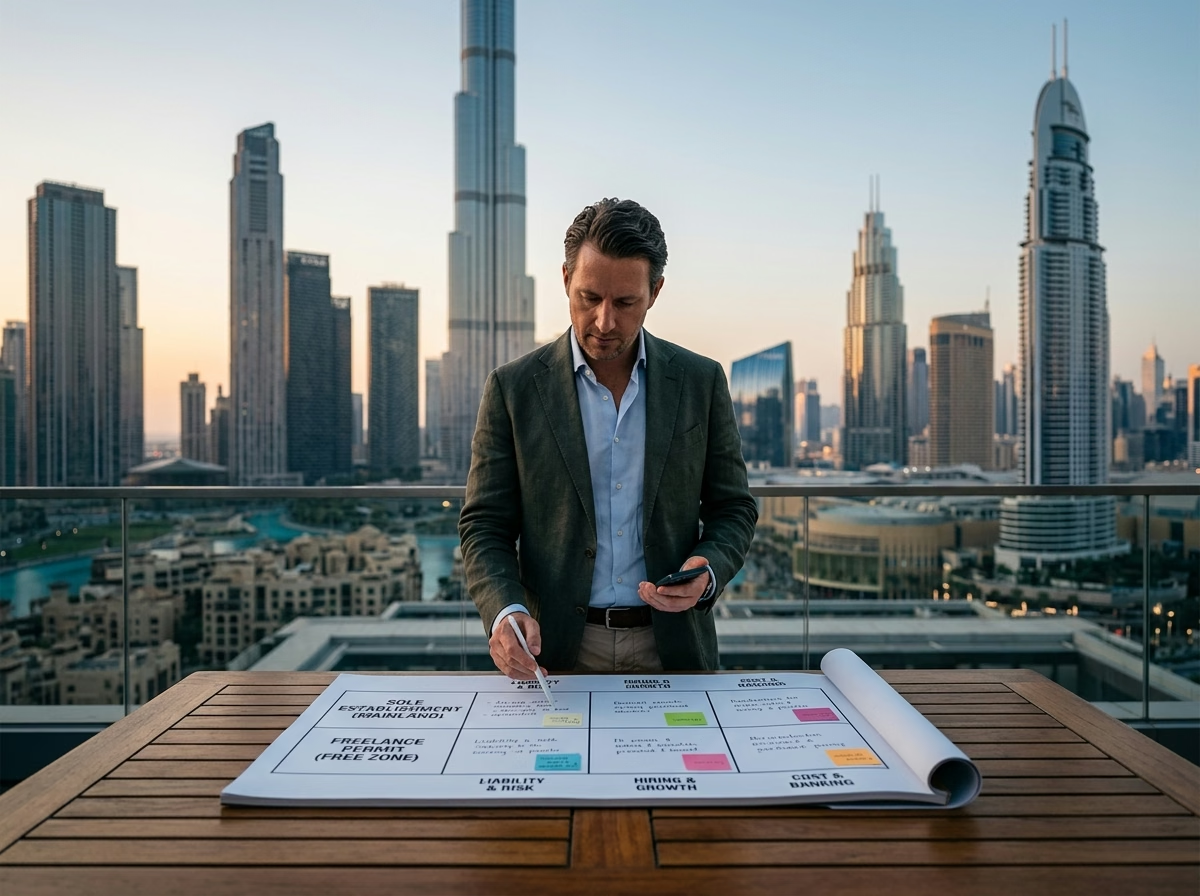
Use Case Matrix: Which Setup Wins?
Eight typical German founder profiles, mapped to the right Dubai jurisdiction
A few business profiles sit on the boundary and need a closer call.
The German consultant who occasionally serves UAE clients
Free zone is still the right starting point. Keep UAE-mainland revenue under the QFZP de minimis threshold (5% of revenue or AED 5 million, whichever is lower) and you stay at 0%. If UAE-mainland revenue grows beyond that, you can either accept the 9% rate on all profit or convert to a dual structure.
The German agency with a few UAE retainer clients
Same answer as the consultant. Watch the de minimis. If UAE revenue is structurally going to dominate, plan for mainland from day one or add a mainland branch.
The German importer / distributor selling to UAE retailers
Mainland from day one. Free zone trading licenses (JAFZA being the main exception for re-export models) cannot directly invoice UAE retail buyers without losing time and margin to a distributor.
The German holding company / family office
Free zone, almost always. ADGM and DIFC are the prestige picks; DMCC is more cost-effective. Read about the structural advantages in our Dubai holding company guide.
The German freelancer who wants the cheapest possible setup
Strongly consider a Dubai freelance permit instead of a full company. Lower fees, simpler bookkeeping, suitable for solo income up to a comfortable level.
How START Recommends Choosing
Between them, our advisors have 20+ years of helping international founders set up in Dubai. Before recommending a jurisdiction, they run a five-question filter.
- Will you sell directly to UAE consumers, UAE retail businesses, or UAE government? If yes, mainland. If no, free zone is on the table.
- Will UAE-mainland revenue exceed 5% of total revenue OR AED 5 million per year? If no, free zone with QFZP saves you the most tax. If yes, the calculation tilts toward mainland.
- Do you need more than 6 visas in the next 12 months? If yes, mainland scales more cleanly via office sqm.
- Are you operating a physical retail, restaurant, clinic, or hands-on service location? If yes, mainland is the only legal option.
- Is your priority a clean, predictable bank account opening? If yes, mainland tends to win, with DMCC, DIFC, and ADGM as free-zone exceptions that bank well.
Four out of five answers pointing to free zone? Set up a free zone Dubai company. Three or more pointing to mainland? Go mainland. If you split 2-and-3, book a free START consultation: the answer depends on revenue split, growth trajectory, family visa needs, and German exit timing.
The Bottom Line for German Founders
A free zone Dubai company is the right answer for most relocating Germans. The combination of 100% foreign ownership, QFZP 0% corporate tax, lower setup costs, bundled visa packages, and minimal office requirements fits the typical German profile (consultant, e-commerce, SaaS, holding, international agency).
A mainland Dubai company is the right answer when your business model needs UAE market access, period. Restaurants, retail, clinics, importers, government contractors, and brokers all need mainland from day one. The higher cost and office requirement is the price of admission to the UAE consumer market.
Both options give you 0% personal income tax. Both apply 100% foreign ownership. Both apply the same 9% UAE corporate tax above AED 375,000 (with QFZP being the free-zone-only exception). Both work for German residency, German exit-tax planning, and Golden Visa eligibility.
Get the free zone vs mainland Dubai decision right at the start. The cost of switching later is meaningfully higher than the cost of one good consultation now.
Contact START for a free consultation. Our advisors map your business model, your German tax exposure, your visa needs, and your banking timeline against every jurisdiction option, then recommend the structure that wins you the most flexibility for the lowest annual cost.